JWST Data Reveal High-Resolution Turbulence in Stellar Nursery
New observations from the James Webb Space Telescope provide an unprecedented view into the chaotic mechanics of star formation, capturing the violent interactions of gas and radiation within a dense galactic nursery.
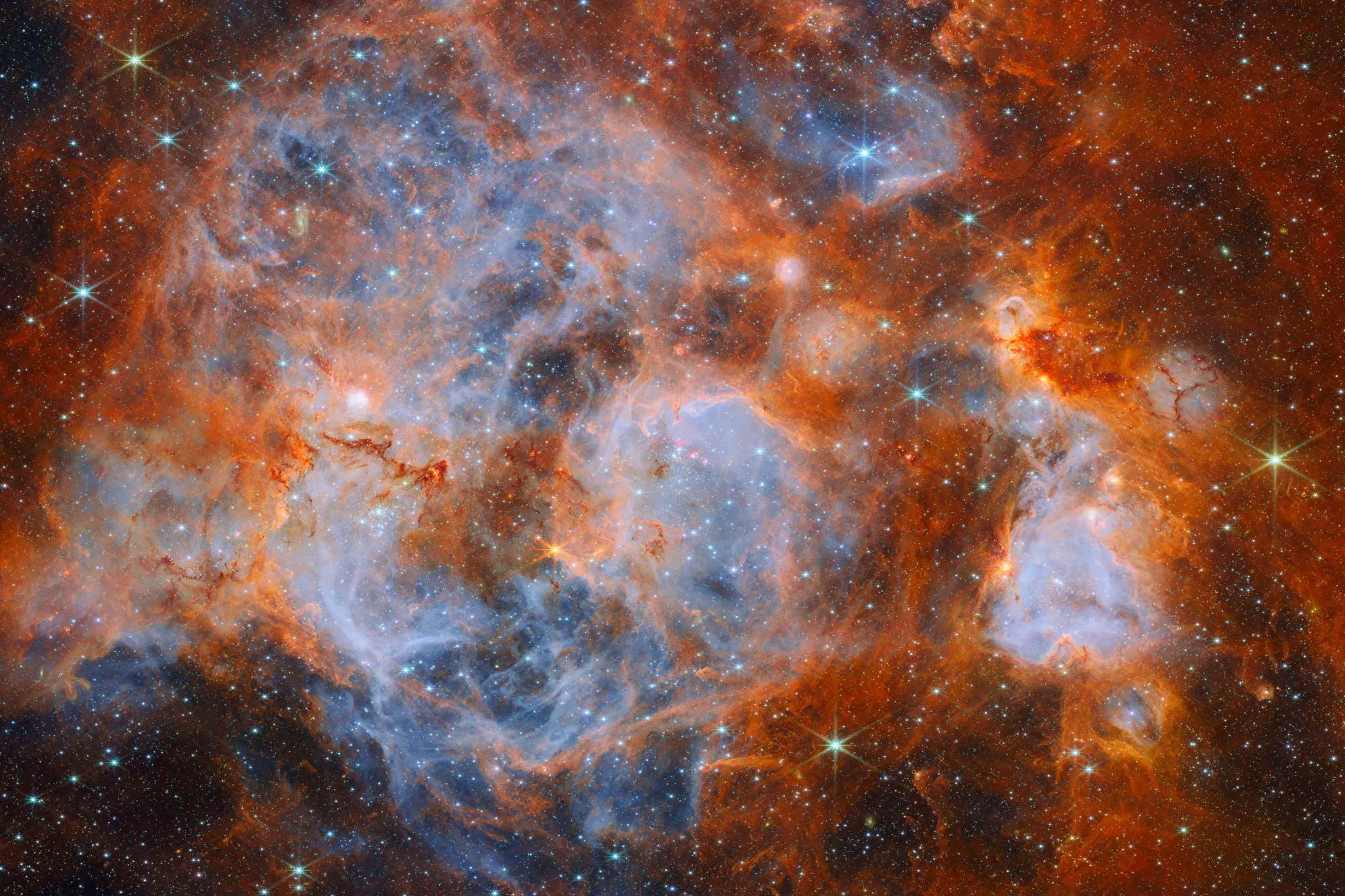
DATA FEED: STAR FORMATION DYNAMICS
The James Webb Space Telescope (JWST) has deployed its infrared suite to penetrate the shroud of a highly turbulent stellar nursery. According to NASA Breaking News, the latest imaging confirms the complex interplay between massive, newborn stars and the volatile environments that gestate them.
THERMAL DYNAMICS AND RADIATION
The captured data highlights the high-energy environment where stellar birth occurs. High-mass stars emit intense ultraviolet radiation and stellar winds that carve massive cavities into the surrounding molecular clouds. This process—known as feedback—triggers a chain reaction of gas compression that can lead to the formation of secondary stellar systems.
Unlike previous-generation observatories, Webb’s Near-Infrared Camera (NIRCam) and Mid-Infrared Instrument (MIRI) allow researchers to bypass the opaque dust that typically obscures these regions. The resulting datasets provide a granular look at the shockwaves and filaments of gas that define the structure of the nursery.
OBSERVATIONAL IMPACT
These observations are critical for refining current cosmological models regarding the efficiency of star formation. By mapping the movement and temperature of interstellar gas, astrophysicists can better predict how galaxies evolve over time. The turbulent nature of these nurseries suggests that star birth is not a passive process, but a violent, self-regulating mechanism that determines the long-term chemical composition of the cosmos.