JWST Confirms Historic Stellar Merger in V1309 Scorpii
New data from the James Webb Space Telescope has definitively confirmed the first recorded instance of a contact binary system merging into a single stellar entity.
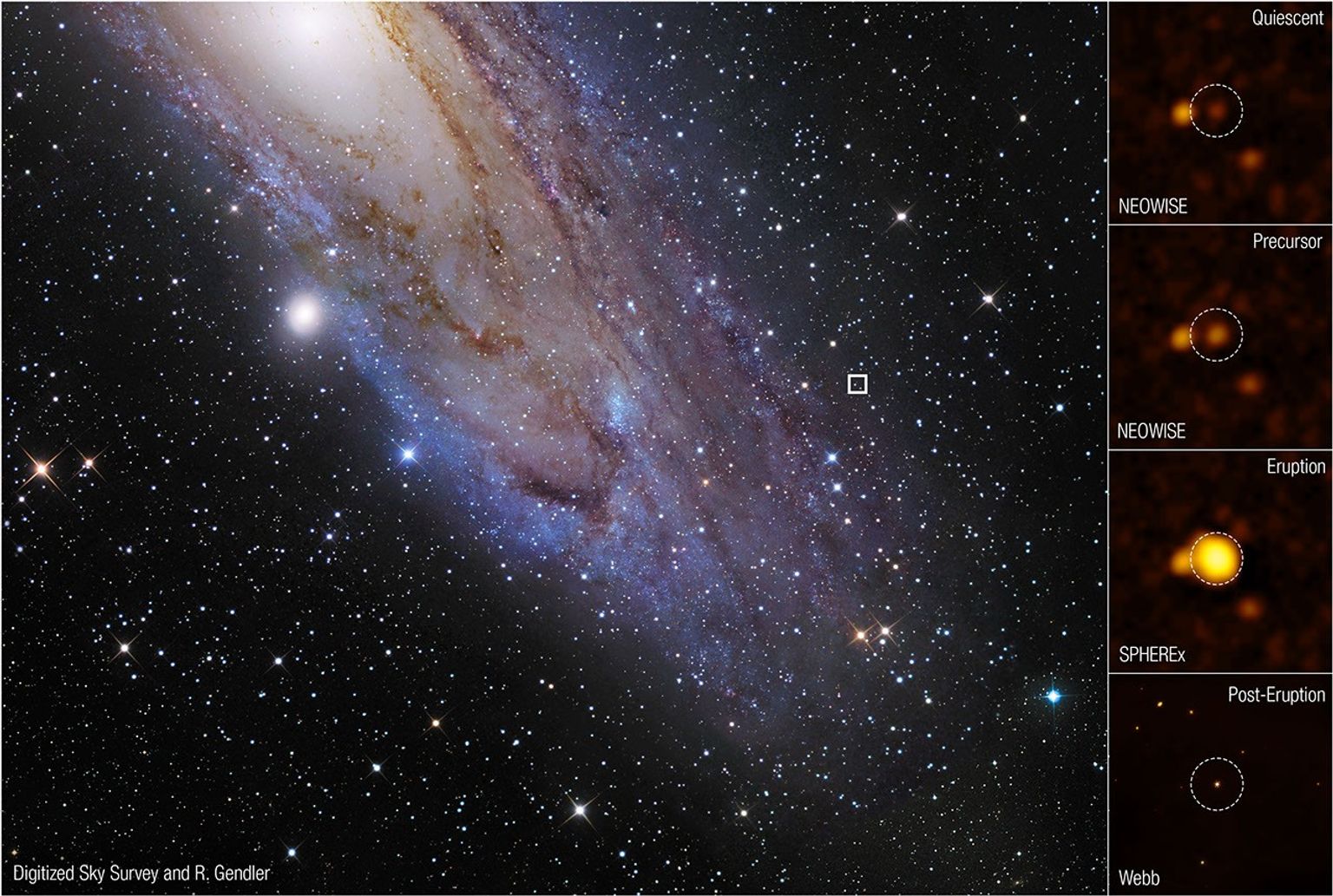
# Stellar Synthesis Confirmed
Deep-space telemetry has resolved a decade-long astrophysical debate. According to NASA Breaking News, data harvested by the James Webb Space Telescope (JWST) has formally confirmed the first-of-its-kind stellar merger within the system V1309 Scorpii.
The Incident
Originally observed as a nova-like event in 2008, V1309 Scorpii was long suspected to be the result of a "contact binary"—two stars orbiting so closely they eventually share a common envelope of gas. As the stars spiraled inward, their orbital period shortened rapidly until the pair coalesced into a single, rejuvenated star.
The Evidence
While ground-based observations provided initial theories, JWST’s Mid-Infrared Instrument (MIRI) and Near-Infrared Spectrograph (NIRSpec) have provided the definitive chemical signature of the aftermath. The telescope detected specific isotopic ratios and dust compositions that only occur when the internal layers of stars are violently mixed and ejected during a merger. The data indicates a significant expansion of the stellar radius and a distinct thermal profile consistent with theoretical models of post-merger evolution.
Mission Impact
This confirmation validates decades of theoretical physics regarding binary evolution. The JWST findings provide a high-resolution template for identifying similar events across the Milky Way, allowing astronomers to predict which close-binary systems are approaching their terminal phase. By documenting the specific light curves and infrared shifts of V1309 Scorpii, mission controllers now have a "fingerprint" for the birth of merged stars.