Juice Logs Critical 2026 Earth Flyby: Trajectory Delta Verified
ESA’s Jupiter Icy Moons Explorer has successfully executed its September 2026 Earth gravity assist, gaining 3.5 km/s in velocity to facilitate its deep-space transit to the Jovian system.
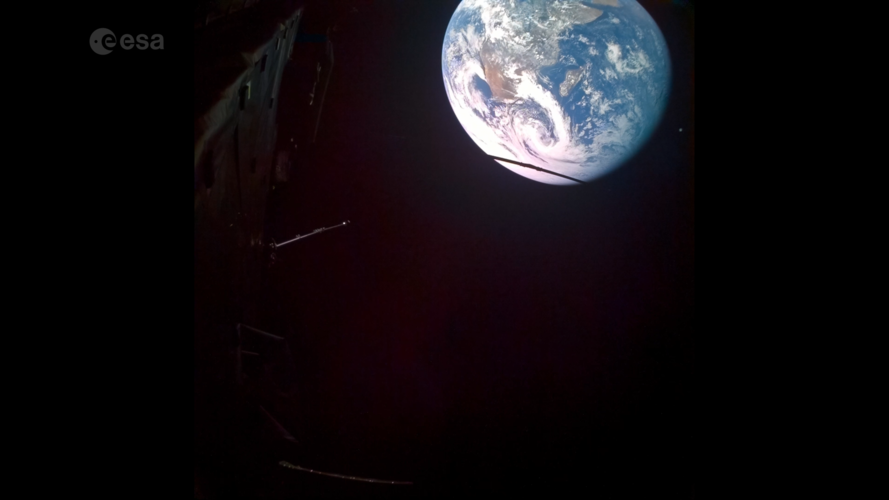
# Orbital Dynamics: Juice Intersects Earth
On 28 September 2026, the Jupiter Icy Moons Explorer (Juice) successfully executed a critical gravity assist maneuver, utilizing Earth’s orbital energy to calibrate its long-range trajectory. According to ESA, the encounter served as a high-precision velocity injection, increasing the spacecraft's speed by 3.5 km/s.
The Maneuver Parameters
Flight controllers at the European Space Operations Centre (ESOC) guided the probe through a specific orbital window to maximize the gravitational slingshot effect. This deflection is a prerequisite for the mission's arrival in the Jovian system, ensuring the craft has sufficient kinetic energy to reach the outer solar system without an unsustainable fuel expenditure. The flyby changed the spacecraft’s flight path angle significantly, effectively slingshotting the hardware toward its next deep-space milestone.
Visual Documentation
ESA has released a reconstructed visualization—"Juice’s September 2026 Earth flyby: the movie"—which documents the close-approach sequence. The data confirms that all onboard systems remained nominal throughout the transit. This flyby represents one of several complex planetary interactions required to navigate the inner solar system before Juice can begin its primary scientific objective: investigating the habitability of Jupiter’s Galilean moons.
Next Phase
With the 3.5 km/s velocity gain confirmed, Juice is now on a stable vector. The mission remains on schedule to explore the subsurface oceans of Ganymede, Callisto, and Europa in the 2030s.