Integrating Model-Based Systems Engineering and Fault Management to Enable Autonomous Space Missions
Fully autonomous space mission operations require the ability to detect faults and compensate for them without human intervention. To address this challenge and provide model-based support for system design and operations, it is important to connect fault management (FM) and mode
Search
Suggested Searches
- Climate Change
- Artemis
- Expedition 64
- Mars perseverance
- SpaceX Crew-2
- International Space Station
- View All Topics A-Z
- Home
- Missions
- Humans in Space
- Earth
- The Solar System
- The Universe
- Science
- Aeronautics
- Technology
- Learning Resources
- About NASA
- Español
Highlights
  
Back
- Search All NASA Missions
- A to Z List of Missions
- Upcoming Launches and Landings
- Spaceships and Rockets
- Communicating with Missions
- Artemis
- James Webb Space Telescope
- Hubble Space Telescope
- International Space Station
- OSIRIS-REx
- Explore Earth Science
- Climate Change
- Earth, Our Planet
- Earth Science in Action
- Earth Multimedia
- Earth Data
- Earth Science Researchers
- The Sun
- Mercury
- Venus
- Earth
- The Moon
- Mars
- Jupiter
- Saturn
- Uranus
- Neptune
- Pluto & Dwarf Planets
- Asteroids, Comets & Meteors
- The Kuiper Belt
- The Oort Cloud
- Skywatching
- Exoplanets
- The Search for Life in the Universe
- Stars
- Galaxies
- Black Holes
- The Big Bang
- Dark Matter
- Dark Energy
- Earth Science
- Planetary Science
- Astrophysics & Space Science
- The Sun & Heliophysics
- Biological & Physical Sciences
- Lunar Science
- Citizen Science
- Astromaterials
- Aeronautics Research
- Human Space Travel Research
- Science in the Air
- NASA Aircraft
- Flight Innovation
- Supersonic Flight
- Air Traffic Solutions
- Green Aviation Tech
- Drones & You
- Technology Transfer & Spinoffs
- Space Travel Technology
- Technology Living in Space
- Manufacturing and Materials
- Robotics
- Science Instruments
- Computing
- For Kids and Students
- For Educators
- For Colleges and Universities
- For Professionals
- Science for Everyone
- Requests for Exhibits, Artifacts, or Speakers
- STEM Engagement at NASA
- NASA's Impacts
- Centers and Facilities
- Directorates
- Organizations
- People of NASA
- Careers
- Internships
- Our History
- Doing Business with NASA
- Get Involved
- Contact
- NASA+
- Images
- NASA Live
- NASA Apps
- Podcasts
- Image of the Day
- e-Books
- 3D Resources
- Interactives
- STEM Multimedia
- NASA Brand & Usage Guidelines
Highlights
  
Highlights
  
Highlights
  
Highlights
  
Highlights
  
Highlights
  
Highlights
  
Highlights
  
Highlights

Highlights
  
Highlights
  
7 min read
# Integrating Model-Based Systems Engineering and Fault Management to Enable Autonomous Space Missions
!The headshot image of NASA Science Editorial Team
NASA Science Editorial Team
Aug 25, 2026
Article
Contents
- The QSI Approach
- The HelioSwarm Demonstration
- Relevance to future NASA missions and non-NASA applications
Fully autonomous space mission operations require the ability to detect faults and compensate for them without human intervention. To address this challenge and provide model-based support for system design and operations, it is important to connect fault management (FM) and model-based systems engineering (MBSE). This approach was successfully demonstrated with the model-based generation of a failure modes and effects analysis and fault trees using NASA’s HelioSwarm mission early design information.
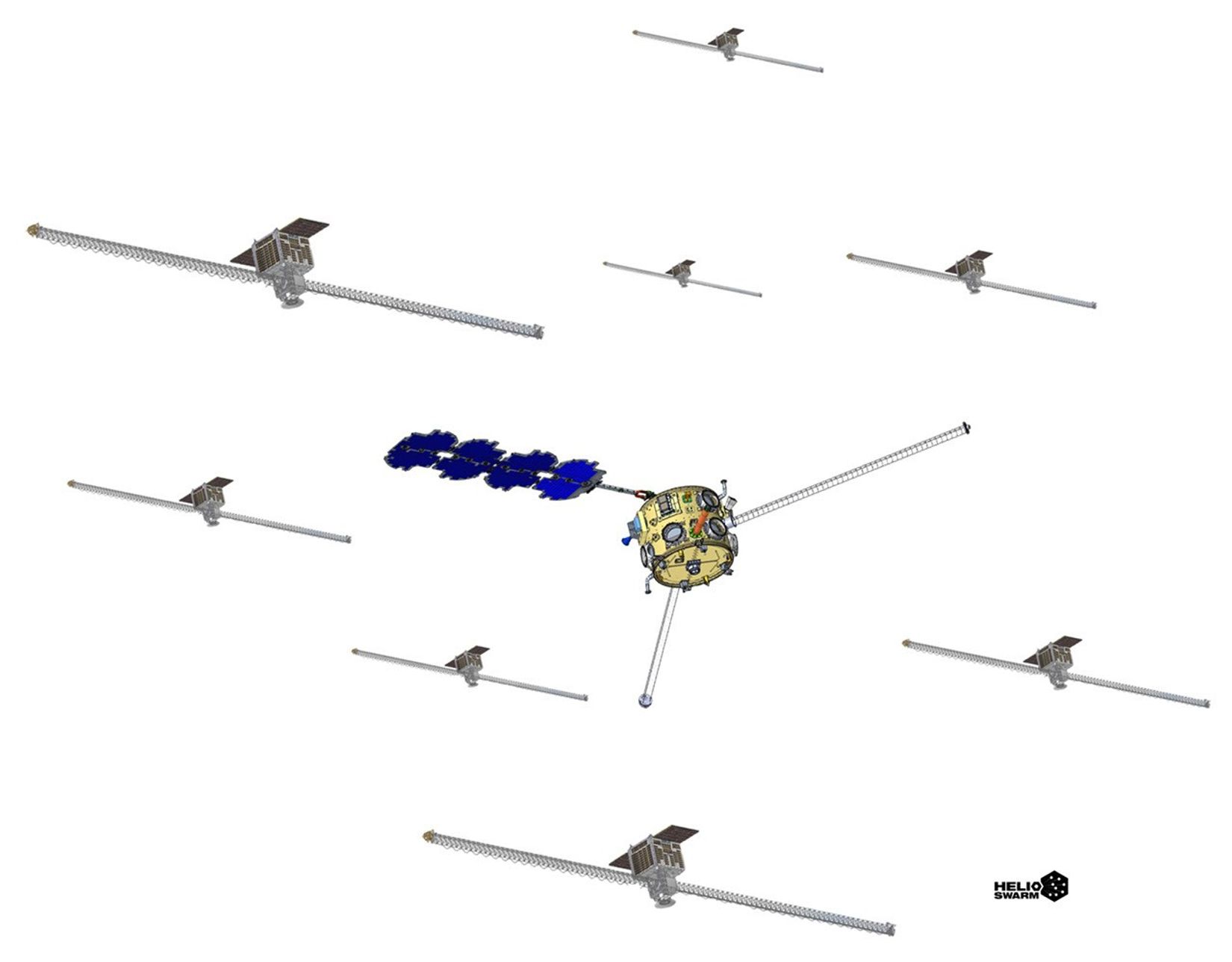
!A group of nine satellites consisting of one hub surrounded by eight small satellites.
Artist’s conception of the future HelioSwarm mission in orbit.
Credit: HelioSwarm Project Team
As NASA strives to push the boundaries of space travel with the Artemis program and the agency’s upcoming deep-space science missions, increased system autonomy and resiliency have inevitably become key technology needs. Autonomous operations require fault management (FM) software to detect issues that occur in space so they can be mitigated automatically without human intervention . Designing autonomous missions requires a multi-disciplinary approach that connects FM with the model-based systems engineering (MBSE) approach used in mission design to ensure that resilient, fault-tolerant systems are architected, modeled, and integrated during the design phase.
To address this need, NASA awarded a Phase II Small Business Innovation Research (SBIR) contract to Qualtech Systems Inc. (QSI) for development of FM capabilities and enhancements to its commercially available toolset, TEAMS® (a product that resulted from commercialization of the company’s earlier NASA-sponsored SBIR work), to support HelioSwarm and other NASA heliophysics missions.
The QSI Approach
One of the most important tasks in this effort was to connect system health management (SHM) and FM to the systems engineering (SE) process. Together, SHM/FM consists of a set of mechanisms that ensure that mission goals are achieved by preventing failures from occurring, or detecting and then mitigating them if they do occur. The SE process coordinates, cross-checks, and integrates system elements to achieve mission goals and is integral during the design, specification, and verification and validation (V&V) of systems. NASA often employs a model-based approach for its SE process, using Systems Modeling Language (SysML) as the framework.
Despite their inherently close relationship to SE in practice, SHM/FM practices have typically not been tightly integrated with SE. Often, SHM/FM is incorporated only after a nominal system is designed, which essentially makes SHM/FM a bandage fix for problems after they occur, without considering how issues might have been prevented. In addition, SE and SHM/FM often involve separate sets of subject matter experts with stove-piped knowledge repositories. This situation can lead to use of modeling methodologies and analyses processes that yield inconsistent results, and can potentially result in inefficiencies throughout the mission life cycle.
This NASA-funded QSI team’s approach integrates SHM/FM directly within the MBSE process from the beginning of a project. This method enables the FM design to be evaluated in an operational context by showing how the SHM/FM schemes mitigate the effects of simulated component-level physical and functional failures. This technique also facilitates trade studies to evaluate the merits of various FM architectures during the design phase.
Under this SBIR effort, QSI worked with the SysML v2 Submission Team (SST) — an assorted group of end users, vendors, academics, and government liaisons involved in the development of specifications for SysML v2, which is the latest iteration of SysML. The QSI team incorporated FM concepts and modeling standards into SysML v2, then they demonstrated how SysML v2 models could translate to the failure space models produced by the QSI toolset.
This capability enables systems engineers to use QSI’s commercial modeling tool set andanalyze the FM aspects of a system design captured in SysML v2. By capturing the causes and impacts of failures, QSI’s toolset enables mission designers to perform Fault Modes, Effects, and Criticality Analyses (FMECAs) and Fault Tree Analyses (FTAs) to analyze, quantify, and improve the diagnostics and availability of the system. Furthermore, the toolset recommends design improvements (e.g., optimal location of sensors onboard the spacecraft) based on the results from such analyses, and it provides these recommendations in industry-standard formats that can be easily understood and incorporated into the design.
During this SBIR effort, theQSI toolset was also enhanced to interface with an MBSE framework and facilitate the creation, evaluation, and selection of FM concepts for a mission design. The toolset now enables FM concepts to be tested early in the design process so that adequate detection and diagnosis can be built into the system design, which could potentially _lower the total cost of development_, facilitate enhanced communication and coordination among mission team members, and reduce development risks (cost and schedule).
The HelioSwarm Demonstration
HelioSwarm will transform our understanding of turbulence in the solar wind and the connected Sun–Earth system. The mission uses a constellation, or “swarm,” of one hub and eight co-orbiting small satellites to make the first simultaneous, multiscale measurements of magnetic-field fluctuations and proton flows in the dynamic cislunar space environment. Because plasma turbulence transfers energy across many scales, from fluid-scale motions to kinetic-scale particle dynamics, it cannot be fully understood from a single measurement point, or from measurements at only a single scale. HelioSwarm’s spacecraft will fly with separations ranging from tens to thousands of kilometers, allowing scientists to reconstruct the three-dimensional structure and dynamics of turbulent space plasma. These observations will reveal how energy moves through the solar wind, transforming our understanding of fundamental plasma processes that operate near Earth, around the Sun, and throughout the universe.
Plasma turbulence is the process by which energy contained in fluctuating magnetic fields and plasma motion cascades from large to smaller spatial scales. When the cascade approaches small spatial scales associated with kinetic dissipation, the energy transfers into particle heat. Without turbulent cascades in space plasmas, most of the universe would be far colder than observed. Because of the fundamental thermodynamic role it plays in fluids, including space plasmas, many contend that turbulent fluids are the most important unsolved problem in classical physics.
The QSI team created a SysML v2 design model of HelioSwarm subsystems and top-level mission requirements, capturing the flowdown from mission goals to the design. The team then used its enhanced toolset to translate the HelioSwarm SysML v2 model into an FM model. The HelioSwarm models consist of key subsystems of the hub spacecraft and eight node satellites, including subsystems for command and data handling; electric power; attitude control; propulsion, thermal, and separation hardware payload sensors; and ground and space communications. Using the QSI toolset, mission designers then generated FMECAs and FTAs that were translated into a standardized SysML report. Furthermore, these FM analyses generated recommendations (e.g., for sensor placement) that were provided as proposed updates to the system design. This process will support the design of small spacecraft swarms with inherent redundancy to enhance science observations and other NASA goals, such as providing mission support for lunar surface operations.
Relevance to future NASA missions and non-NASA applications
The technology developed via this latest SBIR effort could be of high value for future NASA missions — especially those that require autonomous operation. The QSI TEAMS® toolset was baselined for Vehicle Systems Management functions on NASA’s Gateway project and retains applicability to future human-rated spacecraft. System design engineers could use this technology to incorporate fault mitigation strategies to improve design with additional insight into the overall system resilience — right at the beginning of the design phase.
This technology may also have applications outside of NASA. Comprehensive and efficient FM analyses and architecture trade studies are of critical importance to complex and high-value military systems such as aircraft, surface ships, submarines, and even modern ground-fighting vehicles. Additionally, this technology could be applicable to emerging commercial space systems, civilian aircraft and maritime systems, transportation, and power generation and distribution equipment.
For additional details about this effort, see the relevant TechPort entries: here, here, and here.
Project Lead(s): Dr. Sudipto Ghoshal, Mr. Deepak Haste, Qualtech Systems, Inc.
Sponsoring Organization(s): NASA Ames Research Center
Share
Details
Last Updated
Aug 25, 2026
Editor
NASA Science Editorial Team
Related Terms
Explore More


Δ
Did you find what you were looking for?(Required)
Yes
No
Partly
What were you looking for?(Required)
0 of 1000 max characters
What were you hoping to accomplish by visiting our website?(Required)
0 of 3000 max characters
×
Notifications