Imaging the Lighthouse Nebula: Chandra and IXPE Trace Pulsar Magnetism
NASA's X-ray observatories have captured high-energy data from the Lighthouse Nebula, revealing the magnetic architecture of a pulsar traveling at 2.5 million miles per hour.
Terminal Feed: High-Energy Astrophysics Division
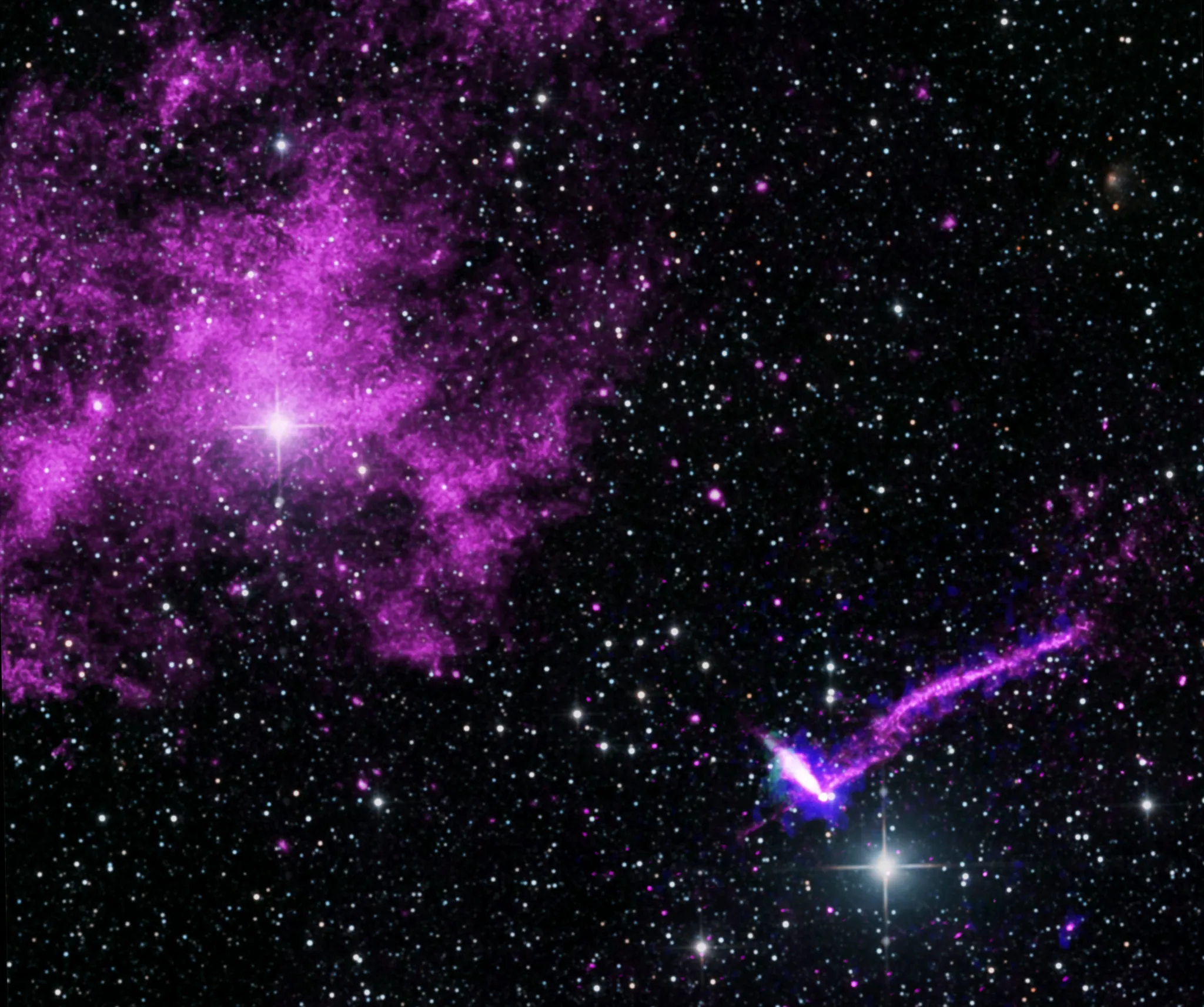
Data retrieved from NASA Breaking News confirms a coordinated observation of the Lighthouse Nebula (IGR J11014-6103) utilizing the Chandra X-ray Observatory and the Imaging X-ray Polarimetry Explorer (IXPE). The target is a rapidly moving pulsar—the dense, rotating remnant of a collapsed star—located approximately 30,000 light-years from Earth.
//Atmospheric Dispersion and Magnetic Trails
Observers have identified a colossal jet of high-energy particles extending from the pulsar, perpendicular to its direction of motion. According to NASA Breaking News, this jet is the longest of its kind ever recorded in our galaxy. The pulsar itself is traversing the interstellar medium at an estimated velocity of 2.5 million miles per hour. This extreme speed, likely the result of an asymmetrical supernova explosion, has created a bow shock and a trailing tail of X-ray emission.
//Polarimetric Analysis
The IXPE instrument has provided critical polarimetry data, allowing researchers to map the orientation of magnetic fields within the nebula. The findings indicate that the magnetic fields are highly ordered and aligned with the pulsar’s jet. This level of synchronization suggests that the particles are being accelerated efficiently along the magnetic lines, maintaining the jet's structure over vast distances.
By combining Chandra’s high-resolution imaging with IXPE’s sensitivity to light polarization, teams are successfully deconstructing the complex physics of pulsar wind nebulae. These environments serve as natural laboratories for studying matter under gravitational and magnetic stresses impossible to replicate on Earth.