HydroGNSS data open for new insights into Earth’s water
The European Space Agency's two-satellite HydroGNSS Scout mission has completed commissioning and is now in full scientific operations.Following extensive testing and validation of the satellites, instruments and ground segment, HydroGNSS data are now freely available to users wo
We use cookies which are essential for you to access our website and/or to provide you with our services, enable you to share our website content via your social media accounts and allow us to measure and improve the performance of our website.
Accept all cookies Accept only essential cookies See our Cookie Notice
!ESA menu toggle!ESA search toggle!ESA title

About ESA
The European Space Agency (ESA) is Europe’s gateway to space. Its mission is to shape the development of Europe’s space capability and ensure that investment in space continues to deliver benefits to the citizens of Europe and the world.
Highlights
Careers \\
\\
 Business with ESA\\
\\
 Newsroom\\
\\
 Education\\
\\
 Kids\\
\\
 ESA Space Shop\\
\\

ESA - United space in Europe
This is ESA ESA facts Member States & Cooperating States Funding Director General Top management For Member State Delegations European vision European Space Policy ESA & EU Space Councils Responsibility & Sustainability Annual Report Calendar of meetings Corporate news
Establishments & sites
ESA Headquarters ESA ESTEC ESA ESOC ESA ESRIN ESA EAC ESA ESAC Europe's Spaceport ESA ESEC ESA ECSAT Brussels Office Washington Office
Working with ESA
Business with ESA ESA Commercialisation Gateway Law at ESA Careers Cyber resilience at ESA IT at ESA Newsroom Partnerships Merchandising Licence Education Open Space Innovation Platform Integrity and Reporting Administrative Tribunal Health and Safety
More about ESA
History ESA Historical Archives Exhibitions Publications Art & Culture ESA Merchandise Kids Diversity ESA Brand Centre
Latest
Story\\
\\

Focus on\\
\\

Press ReleaseN° 5–2026\\
\\
Open
Space in Member States
Find out more about space activities in our 23 Member States, and understand how ESA works together with their national agencies, institutions and organisations.
                      
Science & Exploration
Exploring our Solar System and unlocking the secrets of the Universe
Programmes
Space Science Human and Robotic Exploration
Astronauts
Sophie Adenot\\
\\
 Pablo Álvarez Fernández\\
\\
 Rosemary Coogan\\
\\
 Samantha Cristoforetti\\
\\
 Alexander Gerst\\
\\
 Raphaël Liégeois\\
\\
 Matthias Maurer\\
\\
 Andreas Mogensen\\
\\
 Luca Parmitano\\
\\
 Thomas Pesquet\\
\\
 Marco Sieber\\
\\

Missions
Juice Euclid Webb Solar Orbiter BepiColombo Gaia ExoMars Cheops Exoplanet missions More missions
Activities
International Space Station Orion service module Gateway Concordia Caves & Pangaea Benefits/videos)
Latest
Story\\
\\

Press ReleaseN° 49–2024\\
\\
Open
Focus on\\
\\

Space Safety
Protecting life and infrastructure on Earth and in orbit
About space safety
Protecting our Pale Blue Dot Space Safety at ESA
Asteroids
Asteroids and Planetary Defence Asteroid danger explained Flyeye telescope: asteroid detection Hera mission: asteroid deflection Near-Earth Object Coordination Centre
Space junk
About space debris Space debris by the numbers Space Environment Report In space refuelling, refurbishing and removing
Safety from space
Clean Space Ecodesign Zero Debris Technologies Space for Earth Supporting Sustainable Development
Space weather
Space weather and its hazards ESA Vigil: providing solar warning ESA Space Weather Service Network
Latest
Story\\
\\

Focus on\\
\\

Applications
Using space to benefit citizens and meet future challenges on Earth
Observing the Earth
Observing the Earth Future EO Copernicus Meteorology Space for our climate Satellite missions
Connectivity
Connectivity and Secure Communications ARTES Moonlight Civil security from space
Satellite navigation
Satellite navigation Galileo EGNOS NAVISP Genesis Celeste
Commercialisation
ESA Commercialisation Gateway Open Space Innovation Platform Business Incubation ESA Space Solutions
Latest
Story\\
\\

Press ReleaseN° 1–2024\\
\\
Open
Focus on\\
\\

Enabling & Support
Making space accessible and developing the technologies for the future
Building missions
Space Engineering and Technology Test centre Laboratories Concurrent Design Facility Shaping the Future Discovery and Preparation Advanced Concepts Team ESA Young Professionals Satellites
Space transportation
Space Transportation Ariane Vega Space Rider Future space transportation Boost! Europe's Spaceport Launches from Europe's Spaceport from 2012
Flying missions
Operations ESA ground stations Ground Systems Engineering
Latest
Story\\
\\

Focus on\\
\\

Press ReleaseN° 8–2024\\
\\
Open
The European Space Agency's two-satellite HydroGNSS Scout mission has completed commissioning and is now in full scientific operations.
Following extensive testing and validation of the satellites, instruments and ground segment, HydroGNSS data are now freely available to users worldwide, opening new opportunities to advance our understanding of water availability and the impacts of climate change on Earth's water cycle.
Launched in November 2025, the HydroGNSS satellites use Global Navigation Satellite System Reflectometry (GNSS-R) to observe key hydrological variables from space.
The mission captures L-band signals transmitted by navigation satellites such as GPS and Galileo after they have reflected off Earth's surface. By comparing these reflected signals with those received directly from the navigation satellites, HydroGNSS can derive information on soil moisture, inundation and wetlands, freeze–thaw dynamics, and above-ground biomass, helping scientists better understand the processes shaping our changing planet.
HydroGNSS uses GNSS reflectometry to ‘scout’ for water
Over the last eight months, mission teams have carefully evaluated the satellites' performance, verified the instruments, and calibrated the data products to ensure they meet mission requirements. The successful completion of commissioning confirms that the satellites and ground segment are performing as expected and are ready for routine operations.
As ESA's first Scout mission, developed under the Earth Observation FutureEO programme, HydroGNSS exemplifies the New Space approach. The Scout programme enables innovative mission concepts and emerging satellite technologies to be developed and demonstrated rapidly and cost-effectively.
Using this approach, the mission was developed for ESA by Surrey Satellite Technology Ltd (SSTL), which designed, built and now operates the two satellites.
Building on GNSS-R technology previously demonstrated on TechDemoSat-1 and the CYGNSS mission, SSTL developed an advanced instrument capable of exploiting multiple GNSS constellations, frequencies and polarisations to deliver enhanced environmental observations.
Working with an international team of scientific partners, SSTL processes these measurements into data products that provide new information on soil moisture, flooding and wetlands, seasonal freeze–thaw conditions, and vegetation, supporting research into the global water cycle and its response to climate change.
ESA’s Scout Project Manager, Jean-Pascal Lejault, said, “This is a real milestone, not only for the HydroGNSS mission, but also for the Scout component of ESA’s Earth Observation FutureEO programme.
“Reaching full scientific operations demonstrates the success of this innovative approach to developing agile, low-cost Earth observation missions. We would like to thank everyone involved in making this achievement possible – from the engineering and science teams to our industrial and institutional partners. Their expertise, dedication and commitment have brought HydroGNSS from concept to a fully operational mission in orbit, ready to deliver valuable new insights into Earth's water cycle.”

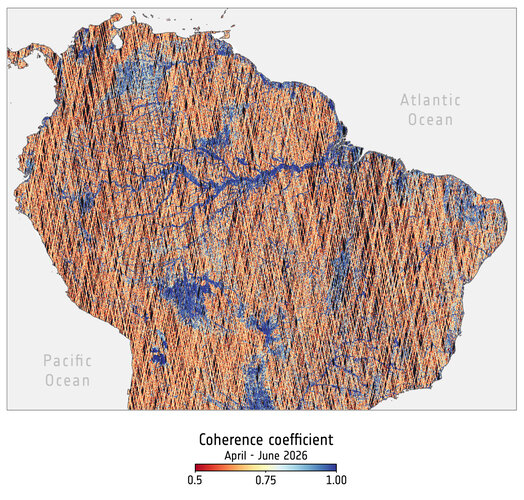
Surface water over South America from HydroGNSS
The images, prepared by IEEC and ICE-CSIC, presented side-by-side above demonstrate HydroGNSS’ ability to detect surface water at high resolution, including beneath vegetation canopies.
The left image shows measurements from HydroGNSS’ coherent channel, which uses the behaviour of reflected GNSS signals to identify water surfaces. The data are collected along satellite tracks at 300 m resolution, with observations from both satellites combined over time to build a more complete picture.
The right image shows a global flood map generated using C-band radar data from Sentinel-1 over the same region. Unlike GNSS-R, radar signals can have difficulty detecting water beneath dense vegetation. HydroGNSS therefore provides a new way to observe wetlands hidden below forest canopies, helping improve estimates of these important ecosystems and their role in the global carbon cycle.
The HydroGNSS Project Manager at SSTL, Peter Garner, said, “After so much hard work by a dedicated team, it is very rewarding to reach this major milestone. I particularly like the circular nature of the overall process at play, with roughly half the reflected signals being collected by this SSTL built pair of satellites being generated by the Galileo navigation satellites’ payloads that were also built and delivered by SSTL, the signals are coming home.”
Users can find more information about HydroGNSS data products and register for access through the SSTL HydroGNSS website.
Related Articles
Story\\
\\

Story\\
\\

Related Links
Focus on\\
\\

Mission\\
\\

Focus on\\
\\

Mission\\
\\

Focus on\\
\\
