Hubble Sensor Capture: The Irregularity of UGC 5189A
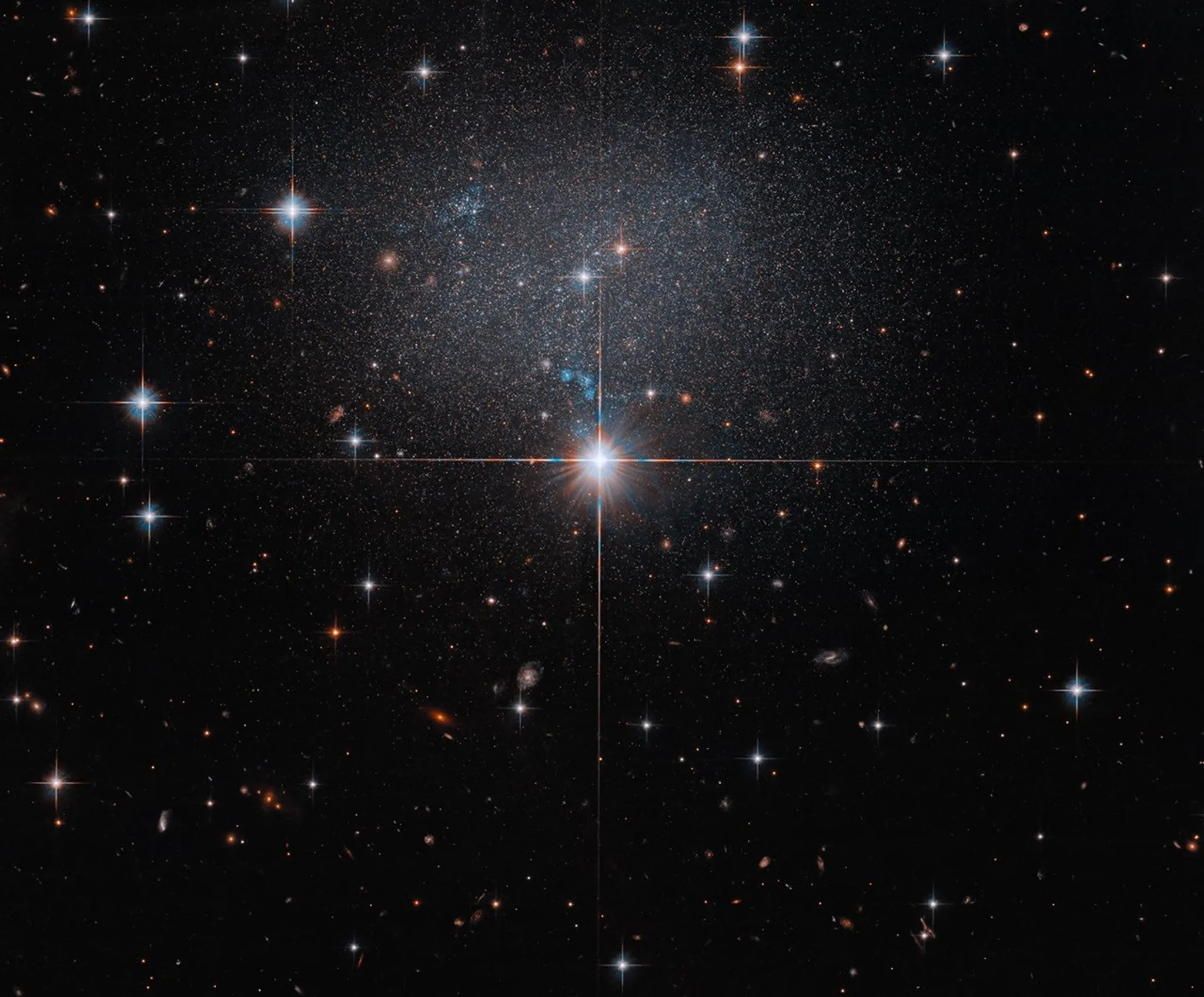
NASA’s Hubble Space Telescope has documented UGC 5189A, a faint irregular galaxy located 150 million light-years away. Recent data highlights its role in the study of Supernova 2010jl.
DATA FEED: GALACTIC ANOMALIES
The Hubble Space Telescope has successfully imaged UGC 5189A, a faint irregular galaxy situated approximately 150 million light-years from Earth in the constellation Leo. Unlike structured spiral or elliptical systems, UGC 5189A exhibits a chaotic morphology, lacking a defined nucleus or symmetry. According to NASA Breaking News, this specific observation was prioritized due to the galaxy's history as a host for high-energy events.
SUPERNOVA ANALYSIS
In 2010, the galaxy was the site of SN 2010jl, a Type IIn supernova of extreme luminosity. Over a three-year period, this single stellar explosion emitted at least 2.5 billion times more energy than the Sun within the visible spectrum. Researchers are utilizing Hubble’s Advanced Camera for Surveys (ACS) to probe the environmental aftermath of the blast. By scanning the debris field and the surrounding star-forming regions, astronomers aim to map the late-stage evolution of massive stars.
OBSERVATION OBJECTIVES
Hubble’s return to UGC 5189A is part of a broader mission to analyze the star clusters that survived the SN 2010jl event. Understanding how these stellar nurseries respond to the shockwaves of a nearby supernova is critical for refining galactic evolution models. The irregular structure of UGC 5189A provides a unique, less-obscured laboratory for observing these interactions in deep space.