Hubble Detects Critical Oxygen Deficit in Local Dwarf Galaxies
A new audit of nearby dwarf galaxies using the Hubble Space Telescope reveals significantly lower oxygen levels than stellar evolution models predict, suggesting cosmic 'leakage'.
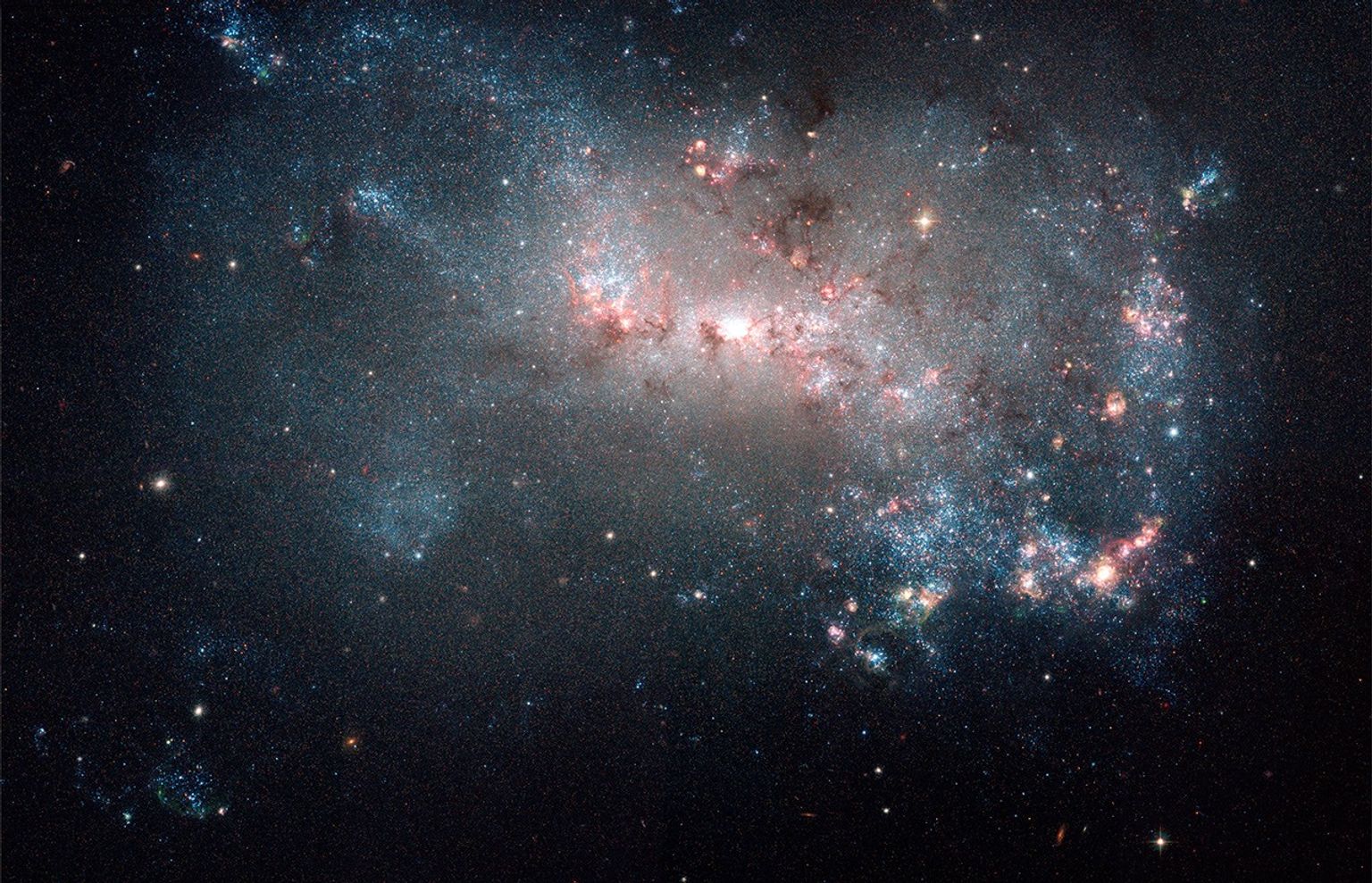
DATA LOG: SPECTROSCOPIC ANOMALY
Recent observations by the Hubble Space Telescope have identified a persistent discrepancy in the chemical composition of nearby dwarf galaxies. According to NASA Breaking News, these small-scale galactic systems contain far less oxygen than standard astrophysical models of stellar life cycles suggest.
ANALYSIS
Stars are essentially nuclear furnaces, fusing lighter elements into heavier ones, including oxygen, throughout their lifespans. When these stars reach their terminal phase—supernova—they disperse these enriched elements into the surrounding interstellar medium (ISM). In theory, dwarf galaxies, which have hosted generations of stars, should be saturated with oxygen. However, Hubble’s Cosmic Origins Spectrograph (COS) reveals a stark shortage.
HYPOTHESIS: THE GALACTIC LEAK
Researchers suggest that dwarf galaxies lack the gravitational mass required to retain their heavy elements. The energy released by supernovae and the radiation pressure from intense star-forming regions likely accelerate these elements to escape velocity. This process ejects oxygen into the vast, low-density intergalactic medium (IGM) before it can be integrated into the next generation of stars or planetary bodies.
MISSION SIGNIFICANCE
This "missing oxygen" problem highlights a fundamental inefficiency in how smaller galaxies recycle matter. While larger galaxies like the Milky Way possess the mass to trap and reuse these elements, dwarf systems act as cosmic chimneys, venting heavy elements into deep space. Understanding this mechanism is vital for refining our maps of cosmic evolution and the distribution of life-essential elements across the local universe.