Hera Mission Achieves Optical Separation of Binary Asteroid System
ESA's planetary defense probe Hera has successfully resolved Didymos and Dimorphos as distinct targets, marking a critical milestone in its long-range navigation phase.
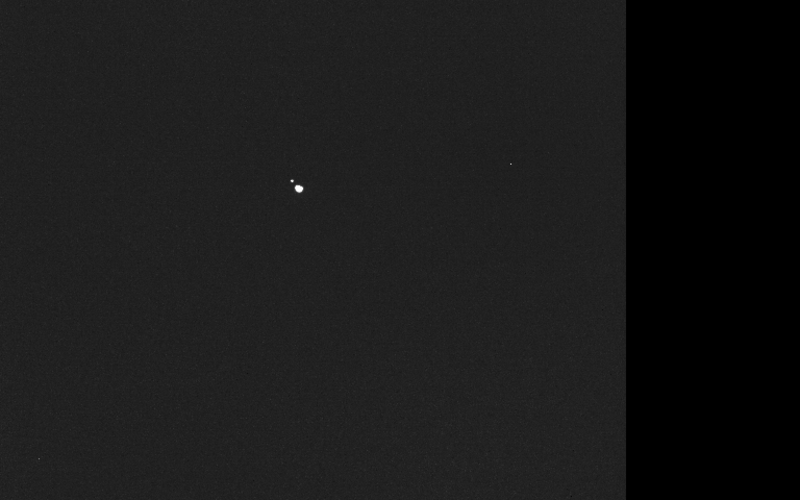
Navigation Confirmation
ESA’s Hera mission has achieved a significant technical milestone by successfully resolving the Didymos binary asteroid system into two distinct objects. According to ESA, the spacecraft’s onboard Asteroid Framing Camera (AFC) captured the "first light" images that differentiate the primary body, Didymos, from its smaller moonlet, Dimorphos.
Targeting the Impact Site
Launched to investigate the aftermath of NASA’s DART mission—which intentionally collided with Dimorphos in 2022 to test kinetic deflection—Hera is currently traversing deep space to conduct a post-impact assessment. Until this recent observation, the pair appeared as a single, undifferentiated point of light. The ability to optically separate the two bodies confirms the spacecraft's long-range navigation instruments are functioning within nominal parameters.
Operational Status
This visual confirmation is essential for the mission's trajectory correction maneuvers. As Hera approaches the system, the AFC and other instruments will provide the data necessary for autonomous navigation. The mission aims to map the crater left by DART, measure the mass of Dimorphos, and determine the internal structure of the asteroid. According to ESA, these findings are vital for validating planetary defense models that could protect Earth from future asteroid threats.
The spacecraft remains on course for its scheduled arrival at the Didymos system in late 2026, where it will deploy two CubeSats, Milani and Juventas, to perform close-range radar and mineralogical scans.