HERA: MAPPING THE AFTERMATH OF A KINETIC IMPACT
ESA's Hera mission prepares for a detailed post-impact survey of the Didymos binary system, providing critical data for planetary defense and asteroid deflection physics.
Mission Parameters
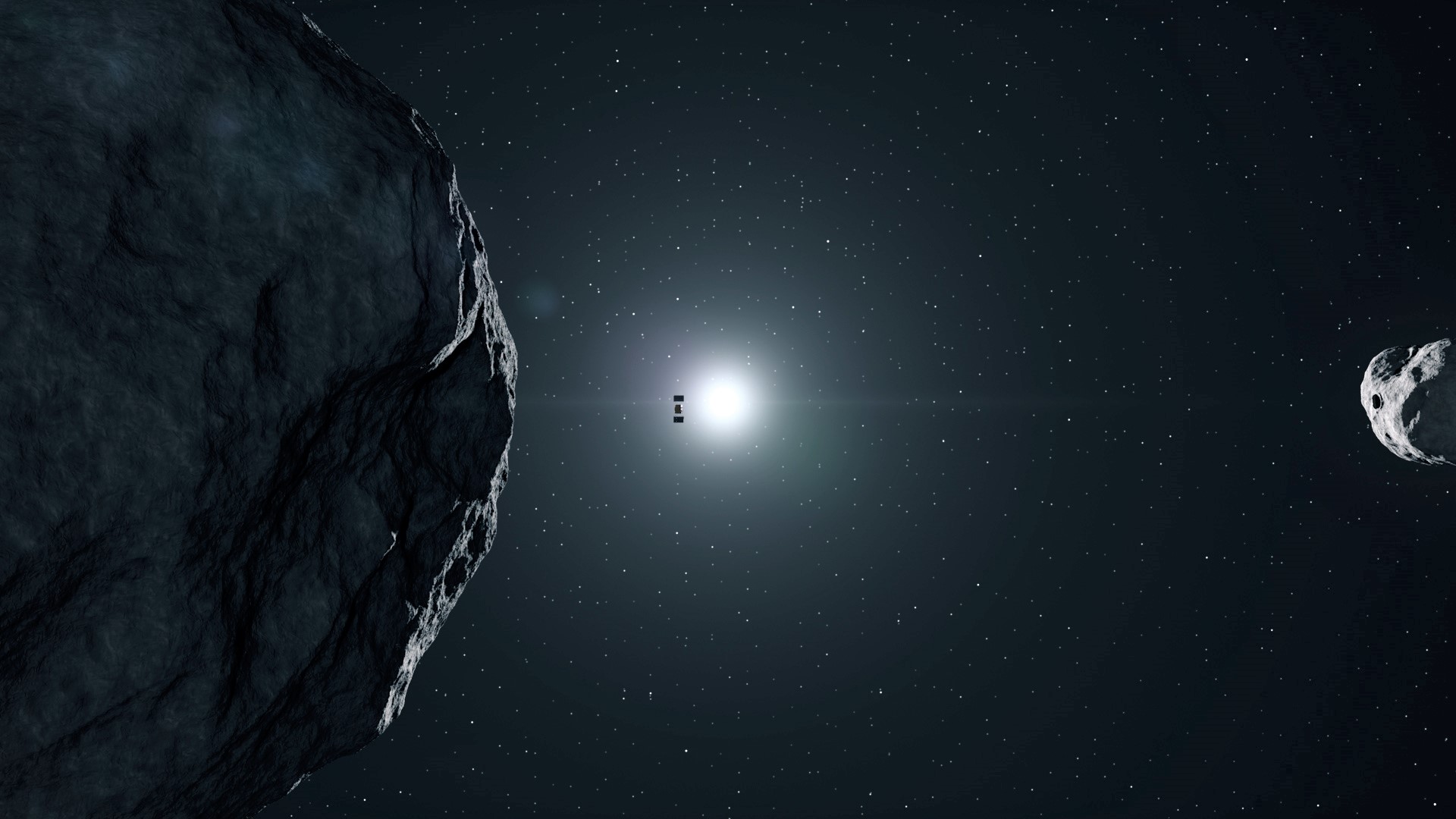
ESA is proceeding with the Hera mission, a planetary defense initiative tasked with investigating the binary asteroid system 65803 Didymos. This mission serves as the follow-up to NASA’s DART (Double Asteroid Redirection Test), which successfully impacted the system’s smaller companion, Dimorphos, in 2022. According to ESA, Hera’s primary objective is to conduct a high-resolution "crime scene investigation" to quantify the efficiency of kinetic impact as a deflection strategy.
The Targets
The target system comprises two distinct bodies. The primary, Didymos, is approximately 780 meters in diameter, rotating rapidly with a period of roughly 2.26 hours. The secondary body, Dimorphos, measures 160 meters across—roughly the size of the Great Pyramid of Giza. Before the DART impact, Dimorphos orbited Didymos every 11 hours and 55 minutes. Post-impact observations suggest this orbital period has been significantly altered, and Hera will provide the definitive measurement of this shift.
Scientific Objectives
Equipped with advanced sensors and two CubeSats—Milani and Juventas—Hera will perform close-proximity operations to map the crater left by DART. The mission aims to measure Dimorphos's mass, composition, and internal structure. The data is essential for validating numerical impact models, ensuring that if a future asteroid threatens Earth, the international community possesses a proven roadmap for redirection.
Per ESA documentation, the mission represents a cornerstone of the agency’s Space Safety program, marking Europe's lead in deep-space exploration and planetary protection technologies. The data gathered will transform a one-off experiment into a repeatable planetary defense technique.