Gravitational Lensing: Cosmic Mirrors Revealed
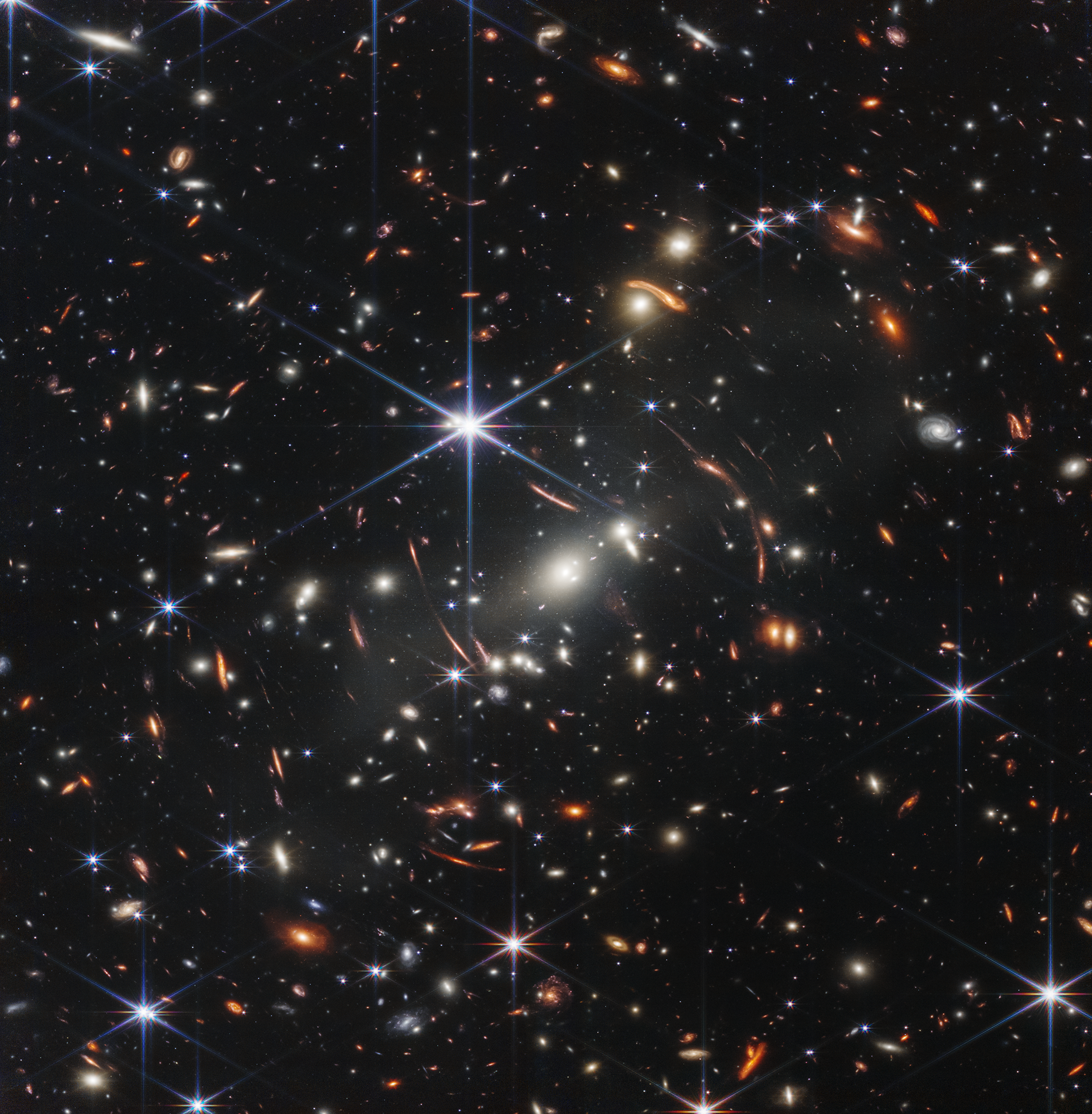
New imaging data from the European Space Agency details a remarkable 'house of mirrors' effect caused by gravitational lensing, where massive galaxy clusters warp the light of distant systems.
DATA OVERVIEW
According to ESA, deep-space observations have identified a complex gravitational lensing phenomenon characterized as a "cosmic house of mirrors." This optical distortion occurs when the immense mass of a foreground galaxy cluster acts as a natural lens, bending and magnifying the light emitted by more distant background galaxies.
MECHANISM OF DISTORTION
Space-time curvature, dictated by General Relativity, causes light paths to deviate when passing through high-density gravitational fields. In this specific sector, the alignment of celestial bodies has resulted in multiple, warped images of the same distant galaxy. These duplicates appear as elongated arcs and fragmented shapes scattered across the field of view.
SCIENTIFIC UTILITY
For ESA researchers, this phenomenon serves as a vital diagnostic tool. By analyzing the specific patterns of distortion, mission scientists can calculate the distribution of both visible and dark matter within the lensing cluster. Furthermore, the magnification allows for the study of ancient, high-redshift galaxies that would otherwise remain invisible to current sensor arrays. This "natural telescope" provides a unique look at the early structural evolution of the universe.
OPERATIONAL STATUS
Advanced imaging continues to map these lensing events to refine cosmological models. The data confirms the efficacy of European orbital assets in capturing high-resolution deep-field metrics, ensuring the continued development of Europe's space capability and scientific leadership in extragalactic research.