GALILEO CONSTELLATION EXPANDS: SATELLITES GSAT0223 AND GSAT0224 OPERATIONAL
Following rigorous in-orbit testing, the European Space Agency confirms two new Galileo satellites have officially entered service, enhancing global positioning precision.
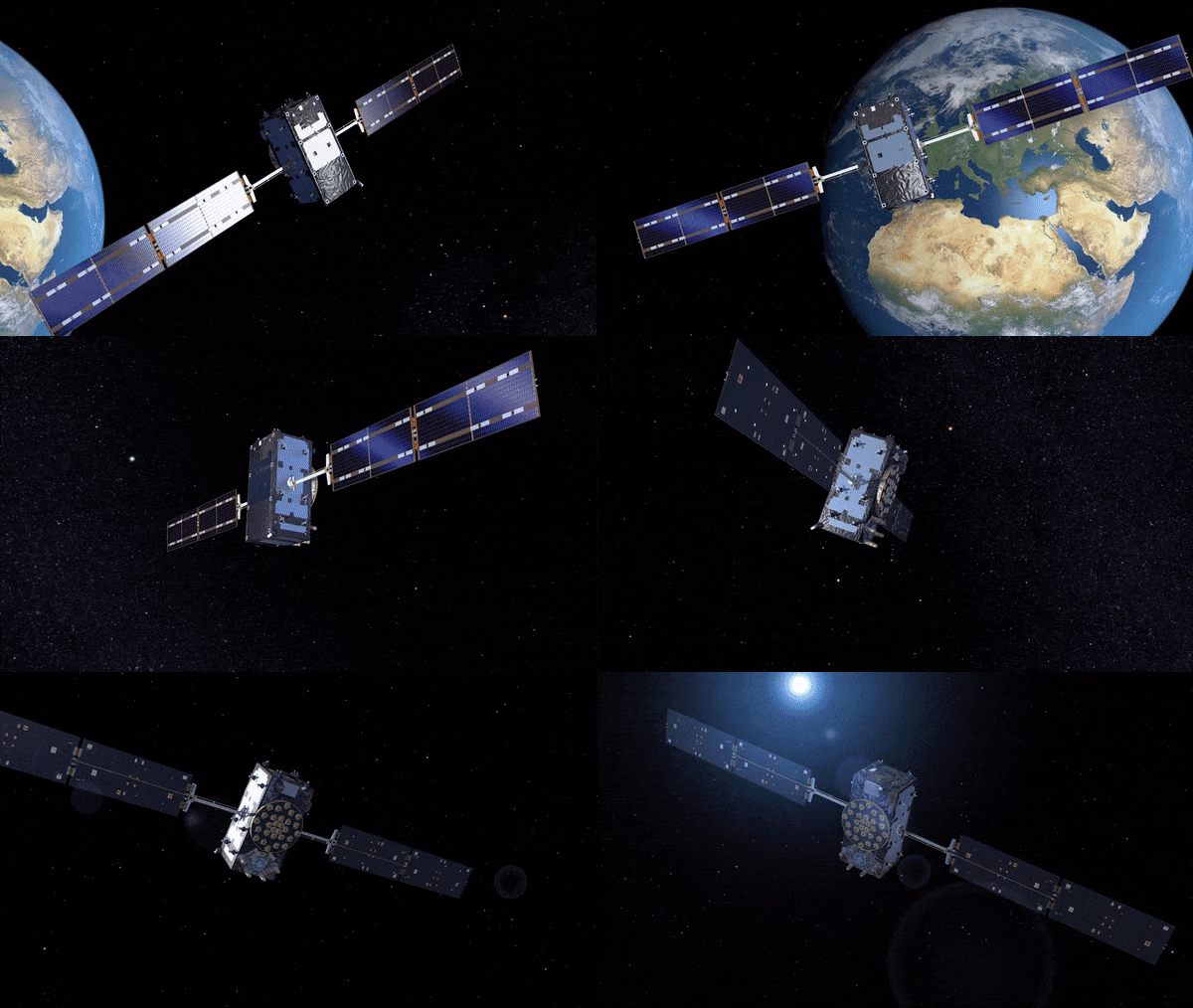
CONSTELLATION STATUS UPDATE
The European global navigation satellite system, Galileo, has formally expanded its operational capacity. According to ESA, two new satellites—designated GSAT0223 and GSAT0224—have successfully completed their commissioning phase and are now broadcasting high-precision timing and positioning signals to users worldwide.
IN-ORBIT TESTING COMPLETE
These units, the first of the final Batch 3 first-generation satellites, were launched in late 2021. Their integration into the active fleet follows an exhaustive period of in-orbit testing (IOT) and system compatibility checks. Technicians at the Galileo Control Centres in Fucino, Italy, and Oberpfaffenhofen, Germany, alongside ESA’s Redu centre in Belgium, verified the integrity of the navigation payloads and the stability of the onboard atomic clocks.
OPERATIONAL IMPACT
The activation of these assets increases the total number of operational satellites in the Galileo constellation to 24, plus spares. This density is critical for maintaining the "Availability of Service" required for high-accuracy applications, including autonomous transport, emergency response, and synchronized telecommunications infrastructure.
According to ESA, the addition of these satellites provides immediate improvements in signal availability and geometry, particularly in high-latitude regions and urban environments where satellite visibility can be obstructed. The constellation remains the world’s most precise civilian positioning system, under the governance of the European Union Space Programme Agency (EUSPA).