Euclid discovers the most ancient quasar in the Universe
We use cookies which are essential for you to access our website and/or to provide you with our services, enable you to share our website content via your social media accounts and allow us to measure and improve the performance of our website.
Accept all cookies Accept only essential cookies See our Cookie Notice
!ESA menu toggle!ESA search toggle!ESA title

About ESA
The European Space Agency (ESA) is Europe’s gateway to space. Its mission is to shape the development of Europe’s space capability and ensure that investment in space continues to deliver benefits to the citizens of Europe and the world.
Highlights
Careers \\
\\
 Business with ESA\\
\\
 Newsroom\\
\\
 Education\\
\\
 Kids\\
\\
 ESA Space Shop\\
\\

ESA - United space in Europe
This is ESA ESA facts Member States & Cooperating States Funding Director General Top management For Member State Delegations European vision European Space Policy ESA & EU Space Councils Responsibility & Sustainability Annual Report Calendar of meetings Corporate news
Establishments & sites
ESA Headquarters ESA ESTEC ESA ESOC ESA ESRIN ESA EAC ESA ESAC Europe's Spaceport ESA ESEC ESA ECSAT Brussels Office Washington Office
Working with ESA
Business with ESA ESA Commercialisation Gateway Law at ESA Careers Cyber resilience at ESA IT at ESA Newsroom Partnerships Merchandising Licence Education Open Space Innovation Platform Integrity and Reporting Administrative Tribunal Health and Safety
More about ESA
History ESA Historical Archives Exhibitions Publications Art & Culture ESA Merchandise Kids Diversity ESA Brand Centre
Latest
Story\\
\\

Focus on\\
\\

Press ReleaseN° 5–2026\\
\\
Open
Space in Member States
Find out more about space activities in our 23 Member States, and understand how ESA works together with their national agencies, institutions and organisations.
                      
Science & Exploration
Exploring our Solar System and unlocking the secrets of the Universe
Programmes
Space Science Human and Robotic Exploration
Astronauts
Sophie Adenot\\
\\
 Pablo Álvarez Fernández\\
\\
 Rosemary Coogan\\
\\
 Samantha Cristoforetti\\
\\
 Alexander Gerst\\
\\
 Raphaël Liégeois\\
\\
 Matthias Maurer\\
\\
 Andreas Mogensen\\
\\
 Luca Parmitano\\
\\
 Thomas Pesquet\\
\\
 Marco Sieber\\
\\

Missions
Juice Euclid Webb Solar Orbiter BepiColombo Gaia ExoMars Cheops Exoplanet missions More missions
Activities
International Space Station Orion service module Gateway Concordia Caves & Pangaea Benefits/videos)
Latest
Story\\
\\

Press ReleaseN° 49–2024\\
\\
Open
Focus on\\
\\

Space Safety
Protecting life and infrastructure on Earth and in orbit
About space safety
Protecting our Pale Blue Dot Space Safety at ESA
Asteroids
Asteroids and Planetary Defence Asteroid danger explained Flyeye telescope: asteroid detection Hera mission: asteroid deflection Near-Earth Object Coordination Centre
Space junk
About space debris Space debris by the numbers Space Environment Report In space refuelling, refurbishing and removing
Safety from space
Clean Space Ecodesign Zero Debris Technologies Space for Earth Supporting Sustainable Development
Space weather
Space weather and its hazards ESA Vigil: providing solar warning ESA Space Weather Service Network
Latest
Story\\
\\

Focus on\\
\\

Applications
Using space to benefit citizens and meet future challenges on Earth
Observing the Earth
Observing the Earth Future EO Copernicus Meteorology Space for our climate Satellite missions
Connectivity
Connectivity and Secure Communications ARTES Moonlight Civil security from space
Satellite navigation
Satellite navigation Galileo EGNOS NAVISP Genesis Celeste
Commercialisation
ESA Commercialisation Gateway Open Space Innovation Platform Business Incubation ESA Space Solutions
Latest
Story\\
\\

Press ReleaseN° 1–2024\\
\\
Open
Focus on\\
\\

Enabling & Support
Making space accessible and developing the technologies for the future
Building missions
Space Engineering and Technology Test centre Laboratories Concurrent Design Facility Shaping the Future Discovery and Preparation Advanced Concepts Team ESA Young Professionals Satellites
Space transportation
Space Transportation Ariane Vega Space Rider Future space transportation Boost! Europe's Spaceport Launches from Europe's Spaceport from 2012
Flying missions
Operations ESA ground stations Ground Systems Engineering
Latest
Story\\
\\

Focus on\\
\\

Press ReleaseN° 8–2024\\
\\
Open
In brief
The European Space Agency’s Euclid space telescope has discovered 31 of the most ancient quasars ever found. Two of these giant and dazzling galaxy cores, powered by gargantuan black holes, are the earliest quasars yet observed in cosmic history. They shone with the light of a trillion Suns back when the Universe was 670 million years old – just 5% of its current age.
In-depth
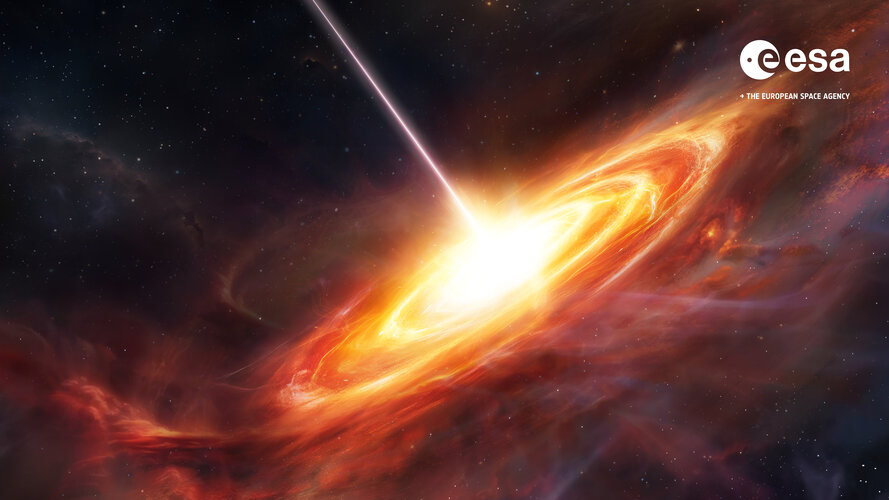
Artist’s concept of an ancient quasar
Quasars represent a brief phase in a galaxy’s life during which large amounts of material spiral into the central supermassive black hole, releasing enormous amounts of energy. In this phase, the galaxy’s nucleus shines more brightly than anything else in the Universe, often outshining the rest of its host galaxy by hundreds to thousands of times.
We’ve been hunting for the Universe’s very first quasars for decades. These objects reveal what was happening during the earliest days of the cosmos, including how the first supermassive black holes and galaxies took shape. However, quasars from this time are difficult to find. They’re rare, as few galaxies had yet had time to grow big enough, and their primordial light is both faint and easy to confuse with that from stars lying closer to us.
Euclid, launched in 2023, is digging deeper into this mystifying part of ancient cosmic history – with exciting results. The telescope has now discovered an unprecedented number of 31 new quasars in the early Universe, pushing back to a time when the cosmos was just 5% of its current age.
“These early quasars date back to the Universe's infancy,” says Daming Yang of Leiden University in the Netherlands, lead author of the Euclid discovery paper. "By finding and studying them, we can better understand how these enormous systems formed and grew so quickly – one of the greatest mysteries in astrophysics.”
Beneath the tip of the iceberg
The earliest quasars we knew of until now were just the tip of the iceberg: the rare and bright outliers that have been easiest to spot. We simply hadn’t found enough quasars from the Universe’s early days to study them properly as a group. Euclid’s new finding changes all that, capturing not just the bright outliers but most of the ancient quasar population.
“Euclid is a true game-changer,” adds Daming. “Before, we could only find a handful of the very brightest ancient quasars, but Euclid lets us search far more efficiently across huge areas of sky to capture much fainter light. It’s a unique tool for quasar hunting.”
The discovery adds 12 new quasars at a ‘ redshift’ – a measure of distance and motion related to how light moves through our expanding cosmos – of 7 or above, corresponding to the first 770 million years of the Universe.
The two most ancient of the batch, EUCL J172902.75+641018.1 and EUCL J125308.55+705432.3, have redshifts of 7.77 and 7.69, respectively, setting a new record for the most ancient quasars ever found. Both lie just over 13 billion light-years away, and emerged during the Universe’s first 670 million years.
“This finding more than doubles the number of quasars we know of that are so ancient,” says Antonio La Marca, an ESA Research Fellow in the Euclid team. Discovering the first 10 or so quasars at a redshift of 7 or above took astronomers more than a decade – but Euclid has already discovered more than that in a single year.
“The Euclid team has taken a true ‘census’ of quasars at the dawn of the Universe for the first time,” adds Antonio. “It’s a big step towards understanding these fascinating objects on a more fundamental level.”
Locations of the 31 new Euclid quasars
A milestone in cosmic history
The second most ancient quasar found by Daming and colleagues was recently studied in more detail by Silvia Belladitta and collaborators. These observations showed that the quasar is embedded in a dusty, gas-filled galaxy that is furiously forming new stars, hinting at what the host galaxy of an early supermassive black hole may be like.
The quasars hark back to a fascinating period in cosmic history known as the ‘ epoch of reionisation’: when everything shifted from being cold and dark (the ‘dark ages’) to hot and ‘ionised’ (split apart by energetic light). This transitional epoch was a crucial era that set the stage for everything we see today.
“Ancient quasars are rare discoveries. They're interesting in themselves, but also time machines that enable us to explore the early Universe and understand how the first generation of galaxies came to be,” says ESA Euclid Project Scientist Valeria Pettorino.
“Euclid’s capabilities are unrivalled. The telescope combines a large area, depth, sharp imaging, and unique space-based infrared vision in a way that lets us pick out rare, extremely distant objects far more efficiently than before.
And it’s not just the telescope: the data processing is only possible thanks to thousands of Euclid Consortium scientists and engineers working together to deliver scientific discoveries, sifting through enormous datasets to identify rare, distant quasars that we can study further using telescopes on the ground.”
The 31 quasars reported here were discovered in data from the Euclid Wide Survey, which will cover more than one-third of the total sky once complete. Euclid will reveal the secrets of the dark Universe; the telescope is exploring its composition, history, evolution, and mapping out its large-scale structure, observing billions of galaxies – and revealing many quasars – as it does so.
Euclid discovers the most ancient quasars in the Universe
Notes to editors
Euclid: Discovery of 31 new quasars at 6.6
The highest-redshift quasar in this work is named EUCL J172902.75+641018.1 (redshift of 7.77), and the second-highest is named EUCL J125308.55+705432.3 (redshift of 7.69). The previous record-holder, discovered in 2021, has a redshift of 7.64.
About Euclid
Euclid launched in July 2023 and started its routine science observations on 14 February 2024. In November 2023 and May 2024, the world got its first glimpses of the quality of Euclid’s images, and in October 2024 the first piece of its great map of the Universe was released. Euclid’s first batch of survey data, including a preview of its deep fields, was released in March 2025. For more of the mission’s discoveries and data releases see: esa.int/Science\_Exploration/Space\_Science/Euclid
Euclid is a European mission, built and operated by ESA, with contributions from its Member States and NASA. The Euclid Consortium – consisting of more than 2000 scientists from 300 institutes in 15 European countries, the USA, Canada and Japan – is responsible for providing the scientific instruments and scientific data analysis. ESA selected Thales Alenia Space as prime contractor for the construction of the satellite and its service module, with Airbus Defence and Space chosen to develop the payload module, including the telescope. NASA provided the detectors of the Near-Infrared Spectrometer and Photometer, NISP. Euclid is a medium-class mission in ESA’s Cosmic Vision Plan.
Contact
ESA Media relations
media@esa.int