ESCAPADE Transmits Deep-Space Portrait of Earth-Moon System
NASA’s Mars-bound ESCAPADE twin spacecraft successfully tested their optical monitoring cameras, capturing a silhouette of the Earth-Moon system from deep space.
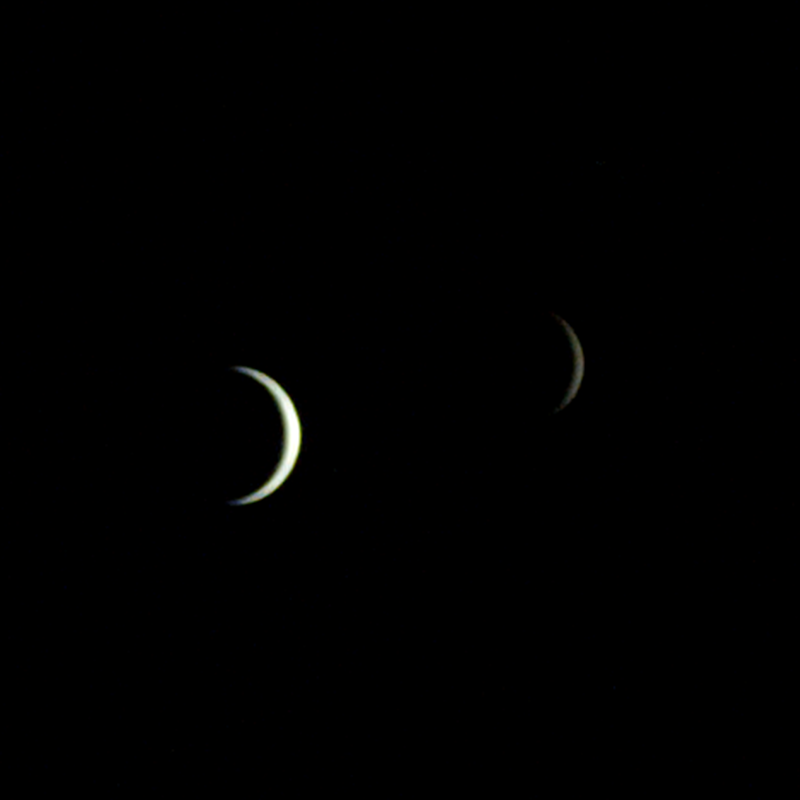
DATA ACQUISITION: OPTICAL TEST SUCCESSFUL
NASA’s Escape and Plasma Acceleration and Dynamics Explorers (ESCAPADE) mission has successfully validated its onboard imaging systems. While transiting toward its eventual Martian trajectory, the mission’s twin spacecraft—Blue and Gold—deployed their monitoring cameras to capture a rare perspective of the Earth-Moon system from deep space. According to NASA Breaking News, the images were acquired as part of a routine instrument health check following the mission's initial launch phase.
SYSTEM STATUS: BLUE AND GOLD OPERATIONAL
The dual-satellite configuration is designed to investigate the complex interactions between the solar wind and the Martian magnetosphere. Ensuring the optical monitoring cameras (OMCs) are functioning at peak efficiency is critical for future proximity operations and orbital insertion maneuvers once the vessels reach the Red Planet. The "family portrait" transmitted back to mission control confirms that the spacecraft’s orientation systems and high-gain antennas are operating within designated parameters.
MISSION OBJECTIVES: THE MARS TRANSIT
This image acquisition serves as more than just a visual milestone. It serves as a calibration benchmark for the scientific instruments that will eventually analyze how the Martian atmosphere is being stripped away by solar radiation. By capturing Earth and its satellite in a single frame, mission controllers can verify the resolution and light-sensitivity levels of the Gold and Blue units. As the twin probes continue their deep-space journey, all systems remain nominal. The mission represents a cost-effective approach to multi-point planetary science, utilizing small-satellite technology to achieve high-priority research goals in the inner solar system.