DUAL-SPECTRUM RECONNAISSANCE: HUBBLE AND WEBB CAPTURE CAT’S HEAD NEBULA
A combined observation effort from the Hubble and James Webb Space Telescopes has revealed new structural data within the Cat’s Head Nebula, merging visible and infrared data streams.
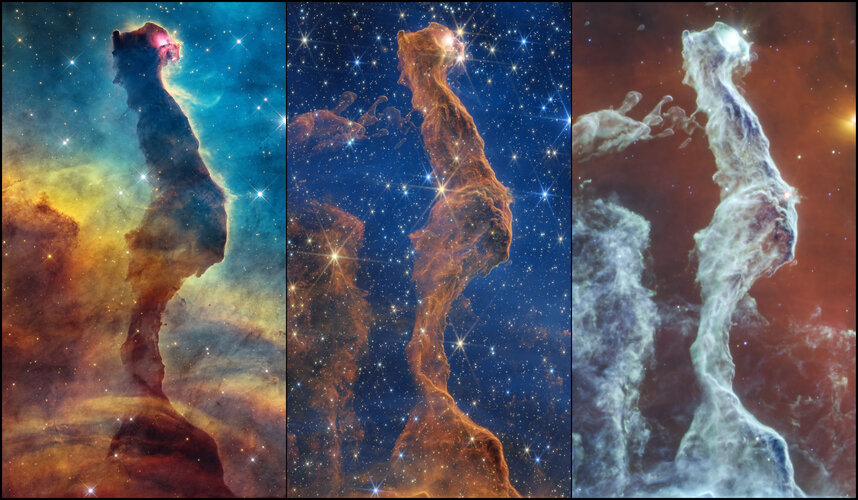
DATA ACQUISITION REPORT
The European Space Agency has synchronized data from two of its primary orbital assets—the Hubble Space Telescope and the James Webb Space Telescope (JWST)—to penetrate the complex architecture of the NGC 6543, commonly known as the Cat’s Head Nebula. According to ESA, this planetary nebula represents the terminal phase of a Sun-like star’s lifecycle, providing a high-fidelity look at stellar dissolution.
TECHNICAL ANALYSIS
The integration of multi-spectral data allows for a more comprehensive understanding of the nebula’s geometry. Hubble’s visible-light sensors capture the ionized gases and the glowing shells of dust ejected by the central white dwarf. In contrast, Webb’s Mid-Infrared Instrument (MIRI) pierces through the translucent layers to reveal thermal signatures and structural details previously obscured by light scattering.
Key findings include:
Concentric Shells: Precise imaging of the nested gas envelopes ejected at 1,500-year intervals.
Dynamic Shockwaves: Observations of fast-moving stellar winds colliding with older, slower-moving material.
* Central Engine: High-resolution monitoring of the dying star at the core, facilitating new models of mass loss.
STRATEGIC RELEVANCE
By layering these datasets, researchers are refining the timeline of the star’s collapse. The Cat’s Head serves as a laboratory for understanding the future of our own solar system. ESA indicates that this dual-view approach is essential for mapping the chemical enrichment of the interstellar medium as heavy elements are dispersed into the surrounding sector.