DATA LOG: Stellar Nucleosynthesis in the Carina Nebula
NASA's latest deep-space imagery reveals the 'Treasure Chest' within the Carina Nebula, a dense cluster of massive stars forging heavy elements 7,500 light-years from Earth.
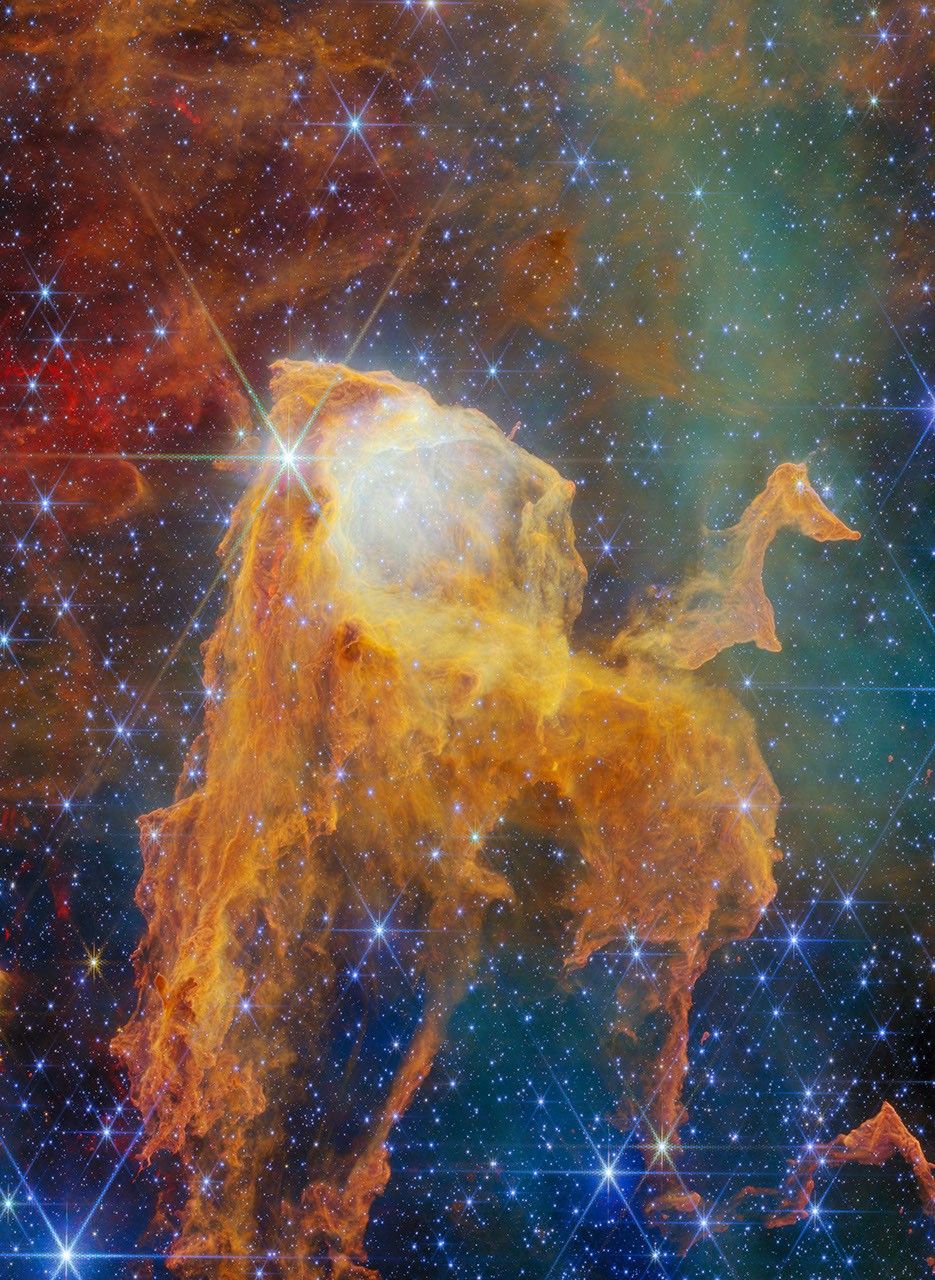
ANALYSIS REPORT: NEBULAR CORE NGC 3372
Telemetry received via NASA Breaking News confirms a high-resolution visual capture of the open star cluster known as the "Treasure Chest." Located approximately 7,500 light-years away within the expansive Carina Nebula (NGC 3372), this region serves as a high-output factory for stellar evolution and heavy element synthesis.
//Stellar Density and Composition
The cluster, cataloged as NGC 3324, consists of a concentrated population of massive, short-lived stars. These entities emit intense ultraviolet radiation and stellar winds, sculpting the surrounding gas and dust clouds into the distinctive "pillars" and "cliffs" observed in the imagery. According to NASA analysts, this radiation is responsible for ionising the hydrogen in the vicinity, creating the ethereal glow characteristic of the Carina complex.
//Kinetic Displacement
The interaction between these stellar giants and their environment is not merely visual. The kinetic energy released by these young stars triggers new cycles of star formation by compressing nearby molecular clouds. This "feedback loop" ensures that the Carina Nebula remains one of the most active star-forming regions in the southern celestial hemisphere.
//Observation Status
While the Carina Nebula spans over 300 light-years, the Treasure Chest cluster offers a localized view of the chaotic conditions prevalent during the early stages of galactic formation. Data confirms the presence of several O-type stars—the hottest and most massive category—which will eventually conclude their lifecycles in violent supernova events, further seeding the interstellar medium with complex elements.