DATA LOG: AUSTALE MONS ANOMALIES
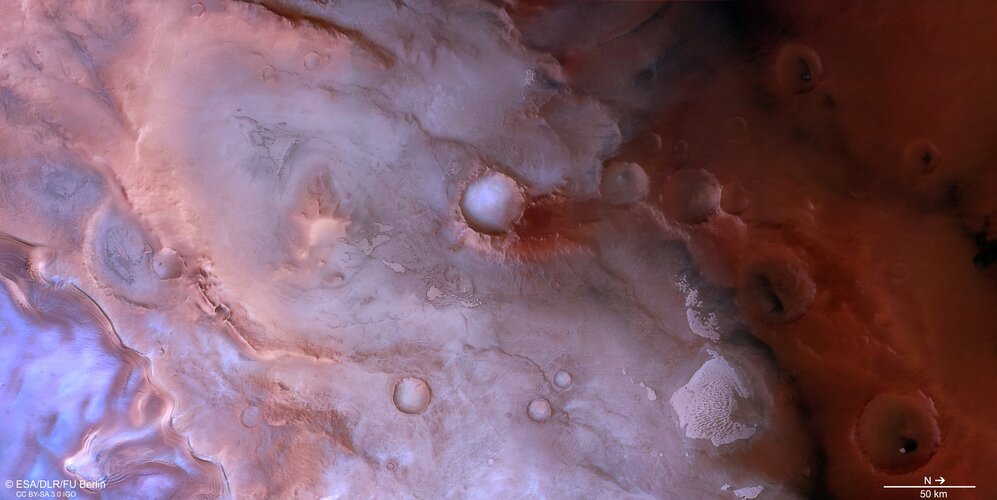
ESA’s Mars Express orbiter has returned high-resolution imagery of the Austale Mons region, revealing unconventional purple-toned sediment swirls near the Martian south pole.
ORBITAL TELEMETRY REPORT
Deep in the Martian southern hemisphere, the Mars Express orbiter has captured a striking geological phenomenon. Data processed by the European Space Agency (ESA) reveals a series of vivid, purple-hued swirls cutting through the landscape of Austale Mons, a region situated near the planet's southern polar ice cap.
According to ESA mission controllers, these chromatic anomalies are not merely aesthetic. The dark, violet-toned ripples are composed of dust and sand rich in volcanic minerals—specifically pyroxenes and olivines. These materials, common in the basaltic crust of Mars, are frequently transported across the surface by high-velocity katabatic winds descending from the polar heights.
GEOLOGICAL MECHANICS
The imagery, captured by the High Resolution Stereo Camera (HRSC), illustrates the complex interaction between seasonal ice and orbital wind patterns. During the Martian winter, a layer of carbon dioxide ice blankets the region. As spring arrives, the sublimation of this ice triggers localized geyser-like activity, ejecting dark subsurface dust that is then sculpted by the atmosphere into the intricate, swirling patterns observed from orbit.
This specific sector of Austale Mons showcases a "raspberry ripple" effect, where the dark volcanic grit contrasts sharply against the reflective, frost-covered plains. ESA scientists note that studying these patterns is critical for mapping the current climate dynamics and wind cycles of the Red Planet.
MISSION STATUS
Mars Express continues its long-term surveillance of the Martian surface, providing essential topographical data for future landing site selection. These latest findings reinforce the agency's understanding of the planet's volatile sediment transport systems.