Curiosity Blog, Sols 5010-5015: Checking out the Bands
Catherine O’Connell-Cooper, APXS Strategic Planner and Payload Uplink/Downlink Lead, University New Brunswick, NB, Canada Earth planning date: Friday, Sept. 11, 2026 This week we had two planning days (Tuesday and Friday), as Monday was Labor Day in North America, where many of t
Search
Suggested Searches
- Climate Change
- Artemis
- Expedition 64
- Mars perseverance
- SpaceX Crew-2
- International Space Station
- View All Topics A-Z
- Home
- Missions
- Humans in Space
- Earth
- The Solar System
- The Universe
- Science
- Aeronautics
- Technology
- Learning Resources
- About NASA
- Español
Highlights
  
Back
- Search All NASA Missions
- A to Z List of Missions
- Upcoming Launches and Landings
- Spaceships and Rockets
- Communicating with Missions
- Artemis
- James Webb Space Telescope
- Hubble Space Telescope
- International Space Station
- OSIRIS-REx
- Explore Earth Science
- Climate Change
- Earth, Our Planet
- Earth Science in Action
- Earth Multimedia
- Earth Data
- Earth Science Researchers
- The Sun
- Mercury
- Venus
- Earth
- The Moon
- Mars
- Jupiter
- Saturn
- Uranus
- Neptune
- Pluto & Dwarf Planets
- Asteroids, Comets & Meteors
- The Kuiper Belt
- The Oort Cloud
- Skywatching
- Exoplanets
- The Search for Life in the Universe
- Stars
- Galaxies
- Black Holes
- The Big Bang
- Dark Matter
- Dark Energy
- Earth Science
- Planetary Science
- Astrophysics & Space Science
- The Sun & Heliophysics
- Biological & Physical Sciences
- Lunar Science
- Citizen Science
- Astromaterials
- Aeronautics Research
- Human Space Travel Research
- Science in the Air
- NASA Aircraft
- Flight Innovation
- Supersonic Flight
- Air Traffic Solutions
- Green Aviation Tech
- Drones & You
- Technology Transfer & Spinoffs
- Space Travel Technology
- Technology Living in Space
- Manufacturing and Materials
- Robotics
- Science Instruments
- Computing
- For Kids and Students
- For Educators
- For Colleges and Universities
- For Professionals
- Science for Everyone
- Requests for Exhibits, Artifacts, or Speakers
- STEM Engagement at NASA
- NASA's Impacts
- Centers and Facilities
- Directorates
- Organizations
- People of NASA
- Careers
- Internships
- Our History
- Doing Business with NASA
- Get Involved
- Contact
- NASA+
- Images
- NASA Live
- NASA Apps
- Podcasts
- Image of the Day
- e-Books
- 3D Resources
- Interactives
- STEM Multimedia
- NASA Brand & Usage Guidelines
Highlights
  
Highlights
  
Highlights
  
Highlights
  
Highlights
  
Highlights
  
Highlights
  
Highlights
  
Highlights
  
Highlights
  
Highlights
  
Curiosity Navigation
3 min read
# Curiosity Blog, Sols 5010-5015: Checking out the Bands
Mars Science Laboratory Mission Team Members
Sep 22, 2026
Article
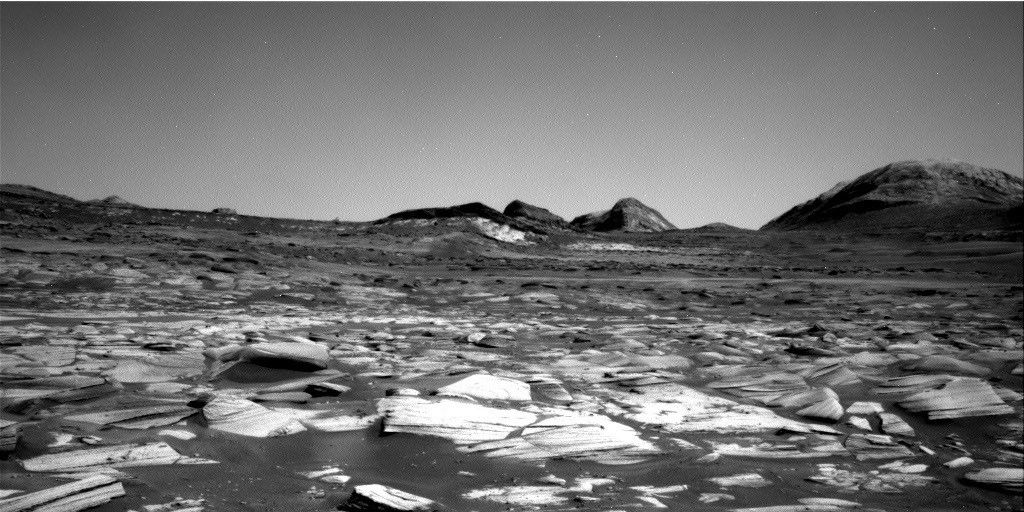
NASA’s Mars rover Curiosity acquired this image, showing the path ahead. The subtle banding can be picked out here in tonal differences. Curiosity captured the image using its Right Navigation Camera on Sept. 14, 2026 — Sol 5014, or Martian day 5,014 of the Mars Science Laboratory mission — at 02:05:20 UTC.
NASA/JPL-Caltech
Catherine O’Connell-Cooper, APXS Strategic Planner and Payload Uplink/Downlink Lead, University New Brunswick, NB, Canada
Earth planning date: Friday, Sept. 11, 2026
This week we had two planning days (Tuesday and Friday), as Monday was Labor Day in North America, where many of the Curiosity team are based. Labor Day (the first Monday in September) marks the end of summer holidays and thrills, and the return to more typical routines and back to school.
The MSL team has marked several important milestones within the past few weeks — marking our 14th “Landiversary” on Aug. 6 and surpassing the 1-kilometer elevation mark and our 5000th sol (Martian day) in early September. Our next big date is not until Nov. 26, the 15th anniversary of launch, and so it feels like Curiosity is also back to a more routine schedule at this point.
We are moving up the valley known informally as “Valle Grande.” In recent weeks, we climbed up over what we interpreted as an “ erosional supersurface” (which marks a gap in the usual rock record) and are now traversing through a subtly banded area. Bands are 25-200 meters (about 80-650 feet) in diameter, with morphological changes, such as bands with more sand and less rocky outcrops (which often appear darker from a distance because there is more sand) and others where outcrops seem more continuous that allow us to mark out rough contacts between them.
The terrain this week was characterized by sparse outcrops with a rough texture, often nodular, surrounded by lots of sand and coarse pebbly sand. On Tuesday APXS and MAHLI investigated brushed nodular bedrock at “ Cerro Armazones” and “ Monte Melimoyu.” ChemCam acquired LIBS on a knot of dark-toned nodules at “Tuta Huallpas” and the dark-toned float rock “Acllahuasi.”
On Friday, after a drive of about 60 meters (nearly 200 feet), we found ourselves with mostly sand close to the rover and just one small rough-textured outcrop close enough for contact science and LIBS. Fortunately, the block was extremely interesting, with abundant small flakes and chips incorporated and laminated areas that are a bit smoother. We will investigate the rougher textures with MAHLI (“ Yungay” and “ Chiu Chiu”), APXS (Chiu Chiu) and ChemCam LIBS (“ Puya Raimondii”) and a smoother area with LIBS (“Liolaemus Tacnae”).
Across both plans, the ChemCam long-distance imager and camera teams were hard at work. In addition to near-field images, which focus on areas close to the rover, both Mastcam and ChemCam acquired several larger mosaics on the buttes on either side of us (“Mishe Mokwa” and “Cordillera”) and looking back to the small butte “La Linea.” Mastcam also took some mosaics documenting the “ Chocolatal” scuff, which we analyzed last week, and a larger mosaic of the “Sullivan Field” sand field where Chocolatal is located. Sullivan Field contains sand ripples, mega ripples, and transverse aeolian ridges, and was named by the team in honor of the late Robert Sullivan, a world expert on Martian sands and cherished member of the Curiosity science team.
In parallel to all the geology activities, the environmental team planned their usual full schedule of monitoring activities, such as dust-devil movies, suprahorizon movies looking at the crater rim, and tau images, which look at dust in the atmosphere.
Navcam and Mastcam acquired images of the path ahead in our drive direction. The subtle bands can just about be picked out here, by looking at tonal differences. It will be very interesting to see how these look and vary from each other when we get close enough to each one.
- ### Want to read more posts from the Curiosity team?
- ### Want to learn more about Curiosity’s science instruments?
Visit the Science Instruments page
NASA’s Curiosity rover at the base of Mount Sharp
NASA/JPL-Caltech/MSSS
Share
Details
Last Updated
Sep 22, 2026
Related Terms
Explore More


Keep Exploring
Discover More Topics From NASA
Mars \\
\\
Mars is the fourth planet from the Sun, and the seventh largest. It’s the only planet we know of inhabited…\\
\\
 All Mars Resources \\
\\
Explore this collection of Mars images, videos, resources, PDFs, and toolkits. Discover valuable content designed to inform, educate, and inspire,…\\
\\
 Rover Basics \\
\\
Each robotic explorer sent to the Red Planet has its own unique capabilities driven by science. Many attributes of a…\\
\\
 Mars Exploration: Science Goals \\
\\
The key to understanding the past, present or future potential for life on Mars can be found in NASA’s four…\\
\\

Δ
Did you find what you were looking for?(Required)
Yes
No
Partly
What were you looking for?(Required)
0 of 1000 max characters
What were you hoping to accomplish by visiting our website?(Required)
0 of 3000 max characters
Submit
×
Notifications