Cosmic Anomaly: Webb Identifies Black Hole Outpacing Host Galaxy
New data from the James Webb Space Telescope reveals an early-universe black hole that grew faster than its surrounding galaxy, challenging established models of cosmic evolution.
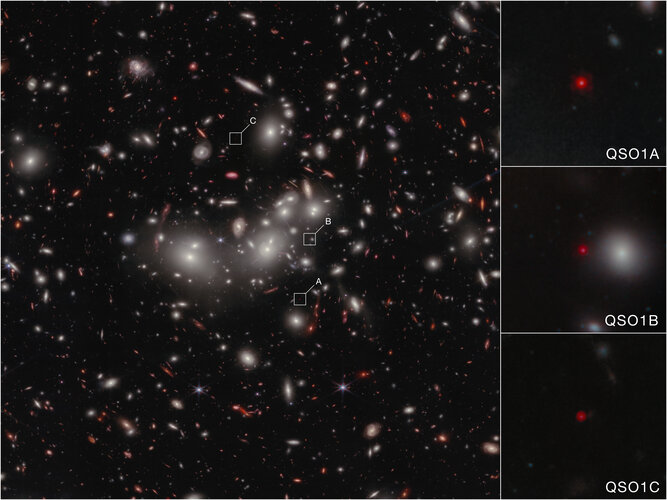
Primary Singularity Growth Detected
Data processed from the James Webb Space Telescope (JWST) has identified a gravitational anomaly in the early universe that upends current astrophysical hierarchies. According to ESA, telescope observations have revealed a supermassive black hole growing significantly faster than its host galaxy, a sequence that contradicts long-standing theories of co-evolution.
The 'Little Red Dot' Chronology
The target, designated Abell2744-QSO1, was observed as it appeared just 700 million years after the Big Bang. In the local and modern universe, black holes and galaxies typically maintain a proportional growth rate. However, this high-redshift specimen displays a mass ratio far skewed toward the central singularity. While the black hole is approximately 10 to 100 million times the mass of our Sun, its host galaxy remains compact and underdeveloped.
Overturning Theoretical Consensus
For decades, the scientific consensus suggested that galaxies and their central black holes grew in lockstep—a symbiotic relationship regulated by stellar formation and feedback. The ESA-backed research suggests a different primordial reality: "heavy seeds" or direct collapse mechanisms may allow black holes to reach massive scales before their surrounding galactic structures even begin to stabilize.
Technical Implications
This discovery was made possible by Webb’s Near-Infrared Camera (NIRCam), utilizing the natural magnifying power of gravitational lensing from the foreground galaxy cluster Abell 2744. By piercing the veil of early cosmic dust, Webb has provided the first definitive evidence of these "over-massive" black holes. The findings suggest that in the infant universe, the engine of the galaxy may have been built long before the chassis.