China Secures Reusable Methalox Lead with Long March 10C Strategy
Following the successful recovery of a Long March 10B booster, China is accelerating the development of the 10C—an all-methalox workhorse designed to dominate the commercial launch sector.
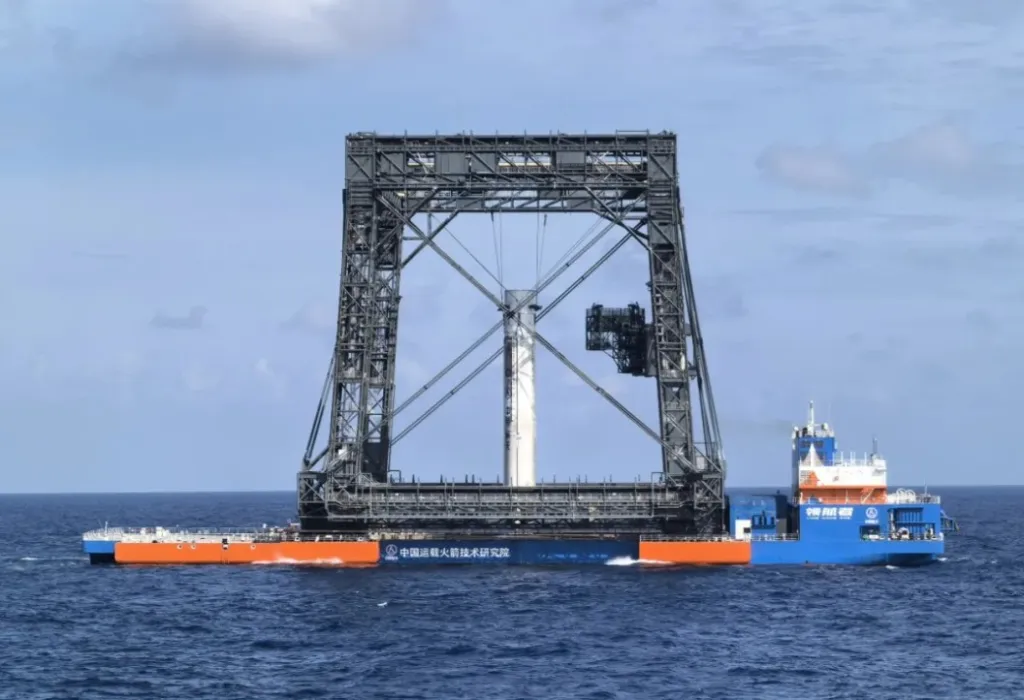
Orbital Recovery Validated
China has solidified its path toward a methane-liquid oxygen (methalox) future. On July 10, the China Academy of Launch Vehicle Technology (CALT) achieved the nation’s first successful orbital booster recovery. According to SpaceNews, the first stage of the Long March 10B was captured downrange from Wenchang using the Linghang Zhe, a recovery vessel equipped with a specialized net system.
The Three-Tiered Long March 10 Strategy
This success paves the way for the Long March 10C, a heavy-lift commercial workhorse. CALT’s modular strategy utilizes three distinct variants based on a 5.0-meter diameter airframe:
- Long March 10A: A kerolox-powered vehicle intended for crewed LEO missions, including the Mengzhou spacecraft.
- Long March 10B: A hybrid model using a kerolox first stage and a methalox second stage. It serves as a data-collection bridge between variants.
- Long March 10C: The final evolution—an all-methalox rocket featuring YF-219 reusable engines.
Experts expect the 10C to exceed the 25,000 kg LEO capacity of the Long March 5B, potentially making it China’s most capable operational launcher. Its reliance on "one diameter, two engine types, and three modules" is designed to optimize manufacturing and rapid flight cadence.
Expanding Infrastructure and Competition
To support these flight rates, CALT and Hainan Commercial Launch are developing two new dedicated pads, expected to be operational by late 2026. Simultaneously, the Shanghai Academy of Spaceflight Technology (SAST) is advancing its own reusable Long March 12 series, recently receiving a $616 million capital injection.
With multiple state subsidiaries and private entities like Landspace pursuing reusable architectures, China is aggressively scaling its infrastructure to deploy massive satellite constellations and secure its dominance in the global launch market.