China’s Landspace recovers booster with second orbital launch of Zhuque-3 rocket
HELSINKI — Landspace successfully landed the first stage of its Zhuque-3 rocket Tuesday following the second launch of the rocket from the Gobi Desert. The second Zhuque-3 rocket lifted off […] The post China’s Landspace recovers booster with second orbital launch of Zhuque

Home / China’s Landspace recovers booster with second orbital launch of Zhuque-3 rocket
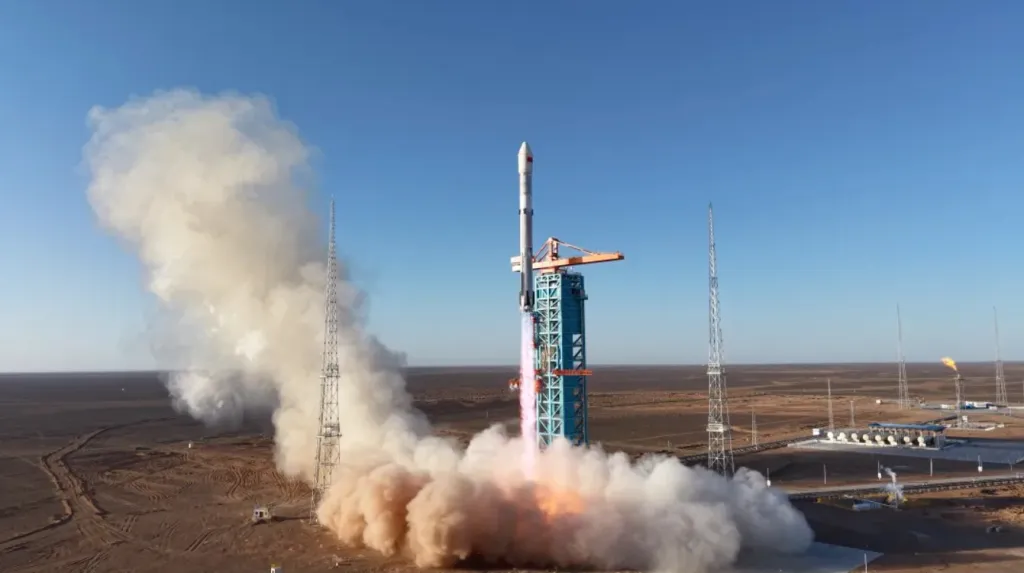
Liftoff of the second Zhuque-3 rocket from Jiuquan spaceport, Aug. 18, 2026. Credit: Landspace
HELSINKI — Landspace successfully landed the first stage of its Zhuque-3 rocket Tuesday following the second launch of the rocket from the Gobi Desert.
The second Zhuque-3 rocket lifted off at 7:35 p.m. Eastern (2335 UTC) Aug. 18 from Dongfeng Commercial Space Innovation Test Zone within the national Jiuquan Satellite Launch Center.
The first and second stages separated 137 seconds into the flight, and the first stage completed a powered descent and vertical landing at a landing site around 390 kilometers downrange in Minqin County, Gansu Province, at 7:43 p.m. Eastern. Landing legs deployed in the final moments of the landing burn ahead of a soft touchdown.
The second stage went on to insert the Honghu 03 satellite into orbit, according to a post-launch Landspace statement. The Honghu 03 satellite was built by Landspace’s satellite manufacturing affiliate, Hongqing Technology, which last month raised more than $191 million.
Twitter Embed

·


Andrew Jones
@AJ\_FI
Successful VTVL landing for Landspace with Zhuque-3 Y2. China's second second successful orbital booster recovery.


Copy link
The successful vertical takeoff, vertical landing is China’s second booster recovery, occurring just over a month after China became the second country to recover an orbital booster with the Long March 10B, that time using a drone vessel at sea equipped with a net-capture system.
Globally, Landspace becomes the third entity, after SpaceX and Blue Origin, to successfully land an orbital booster on legs.
Zhuque-3 is a two-stage, stainless steel rocket with a diameter of 4.5 meters and a mass at liftoff of about 570 metric tons. The rocket stands approximately 66 meters tall on the pad, with its first stage powered by nine Tianque-series methane-liquid oxygen engines. The rocket has a payload capacity to low Earth orbit (LEO) of 21,000 kilograms when expendable, or up to 18,300 kg when the first stage is recovered downrange, making it comparable to the Falcon 9 in terms of payload capacity.
The Zhuque-3 Y2 booster landing comes eight and a half months after the debut flight of the Zhuque-3, which reached orbit, but the first stage recovery attempt ended in failure during the latter stages of powered descent. That mission marked China’s first orbital booster recovery attempt. It was followed weeks later by another attempt by state-owned CASC with the Long March 12A, which also failed.
The post-mission statement from Landspace noted a number of technical changes made in the wake of the failed landing attempt with the first Zhuque-3. These include a reduced number of engines used in the landing burn, which simplified the system and improved reliability, adding a “predicted landing point” to the onboard autonomous safety control system, and improved thermal protection to handle the extreme reentry heating and structural loads.
Landspace joins CASC in successfully recovering an orbital booster and the company says the mission means it moves from the recovery technology verification phase to engineering-scale reuse verification.
“This mission lays a solid foundation for subsequent recovery, maintenance, reuse flights, and commercial applications,” Landspace said.
Landspace stated early in the year that it aimed to launch the second Zhuque-3 in Q2 2026, targeting a reuse of the expected recovered first stage in Q4. The company did not provide a timeline for reuse in the post-mission statement.
Zhuque-3 is expected to support China’s efforts to build the Guowang and Thousand Sails megaconstellations in low Earth orbit. The success will also have relevance for LandSpace’s pending STAR Market IPO bid, and puts the company well ahead of commercial competitors in establishing a reliable medium-lift rocket and demonstrating recoverability and attempting reusability.
The launch was China’s 60th orbital launch attempt of 2026, following successful Long March 12 and Long March 2C missions over the past weekend.
Twitter Embed

·
MISSION SUCCESS \| ZhuQue-3 Y2 Reusable Launch Vehicle Achieved Full Success in Orbital Insertion and First-Stage Recovery
On August 19, 2026, at 07:35 (UTC+8), the ZhuQue-3 (ZQ-3) Y2 reusable launch vehicle lifted off from the Dongfeng Commercial Space Innovation Pilot Zone. Show more

Copy link
_Related_

Andrew Jones
Andrew Jones writes about China's space industry, including civilian programs, space science and exploration, policy, and commercial developments for SpaceNews, and writes the China Report newsletter. He has additional bylines in Scientific American,... More by Andrew Jones
Sign in or register
Close
Continue with Google
Or
Enter the code sent to your email
Email address
Enter your password
Sign in by entering the code we sent to , or clicking the magic link in the email.
ContinueResend codeEmail me a one-time code instead Forgot password Go back
Continue Set a password (optional)
We'll send a verification code to %EMAIL%.
Send code
Skip for now
To continue reading this article:
Register now to get
2 more free articles this month.
You’ll also receive our weekly Editor’s Choice, SpaceNews This Week and Opinions newsletters. Opt-out at any time.
Sign up
Sign in to an existing account
Get unlimited access to SpaceNews.com, the SpaceNews app and our digital monthly magazine for less than $5 per week.
$250/year
Subscribe now
_Cancel anytime. Sales tax may apply. No refunds._ _Terms and conditions apply._
Link
Copy link
Digital All-Access Subscription (Monthly) $25.00 / monthDigital All-Access Subscription (Quarterly) $70.00 every 3 monthsDigital All-Access Subscription (Yearly) $250 / yearDigital All-Access Subscription (2 Years) $450 every 2 yearsPurchase
Sign in to an existing account Cancel
Twitter Widget Iframe
×
