Chasing Fire Clouds in Utah
NASA aircraft are sampling smoke lofted high into the atmosphere by one of the most formidable cloud types in the sky—towering, smoke-infused pyrocumulonimbus.
Search
Suggested Searches
- Climate Change
- Artemis
- Expedition 64
- Mars perseverance
- SpaceX Crew-2
- International Space Station
- View All Topics A-Z
- Home
- Missions
- Humans in Space
- Earth
- The Solar System
- The Universe
- Science
- Aeronautics
- Technology
- Learning Resources
- About NASA
- Español
Highlights
  
Back
- Search All NASA Missions
- A to Z List of Missions
- Upcoming Launches and Landings
- Spaceships and Rockets
- Communicating with Missions
- Artemis
- James Webb Space Telescope
- Hubble Space Telescope
- International Space Station
- OSIRIS-REx
- Explore Earth Science
- Climate Change
- Earth, Our Planet
- Earth Science in Action
- Earth Multimedia
- Earth Data
- Earth Science Researchers
- The Sun
- Mercury
- Venus
- Earth
- The Moon
- Mars
- Jupiter
- Saturn
- Uranus
- Neptune
- Pluto & Dwarf Planets
- Asteroids, Comets & Meteors
- The Kuiper Belt
- The Oort Cloud
- Skywatching
- Exoplanets
- The Search for Life in the Universe
- Stars
- Galaxies
- Black Holes
- The Big Bang
- Dark Matter
- Dark Energy
- Earth Science
- Planetary Science
- Astrophysics & Space Science
- The Sun & Heliophysics
- Biological & Physical Sciences
- Lunar Science
- Citizen Science
- Astromaterials
- Aeronautics Research
- Human Space Travel Research
- Science in the Air
- NASA Aircraft
- Flight Innovation
- Supersonic Flight
- Air Traffic Solutions
- Green Aviation Tech
- Drones & You
- Technology Transfer & Spinoffs
- Space Travel Technology
- Technology Living in Space
- Manufacturing and Materials
- Robotics
- Science Instruments
- Computing
- For Kids and Students
- For Educators
- For Colleges and Universities
- For Professionals
- Science for Everyone
- Requests for Exhibits, Artifacts, or Speakers
- STEM Engagement at NASA
- NASA's Impacts
- Centers and Facilities
- Directorates
- Organizations
- People of NASA
- Careers
- Internships
- Our History
- Doing Business with NASA
- Get Involved
- Contact
- NASA+
- Images
- NASA Live
- NASA Apps
- Podcasts
- Image of the Day
- e-Books
- 3D Resources
- Interactives
- STEM Multimedia
- NASA Brand & Usage Guidelines
Highlights
  
Highlights
  
Highlights
  
Highlights
  
Highlights
  
Highlights
  
Highlights
  
Highlights
  
Highlights

Highlights
  
Highlights
  
Earth Observatory
6 min read
# Chasing Fire Clouds in Utah
Image of the Day for August 17, 2026
NASA aircraft are sampling smoke lofted high into the atmosphere by one of the most formidable cloud types in the sky—towering, smoke-infused pyrocumulonimbus.
NASA Earth Observatory
Aug 17, 2026
Article

View more Images of the Day:

Instruments:
Topics:
Natural Color
Brightness Temperature
NASA Earth Observatory/Michala Garrison
NASA Earth Observatory/Michala Garrison
Natural ColorBrightness Temperature
NASA Earth Observatory/Michala Garrison
NASA Earth Observatory/Michala Garrison
Natural Color
Brightness Temperature
CurtainToggle2-Up
Image Details
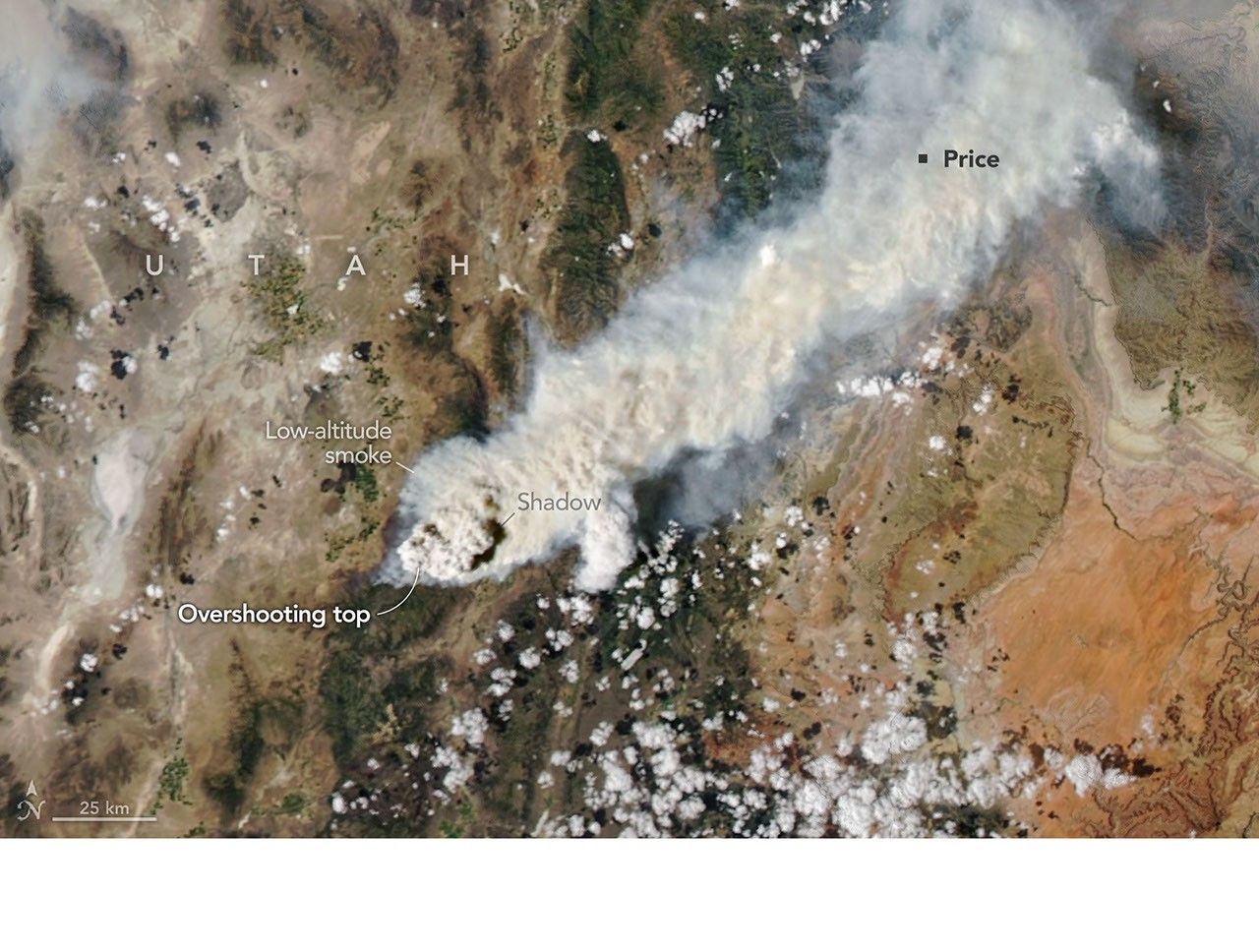
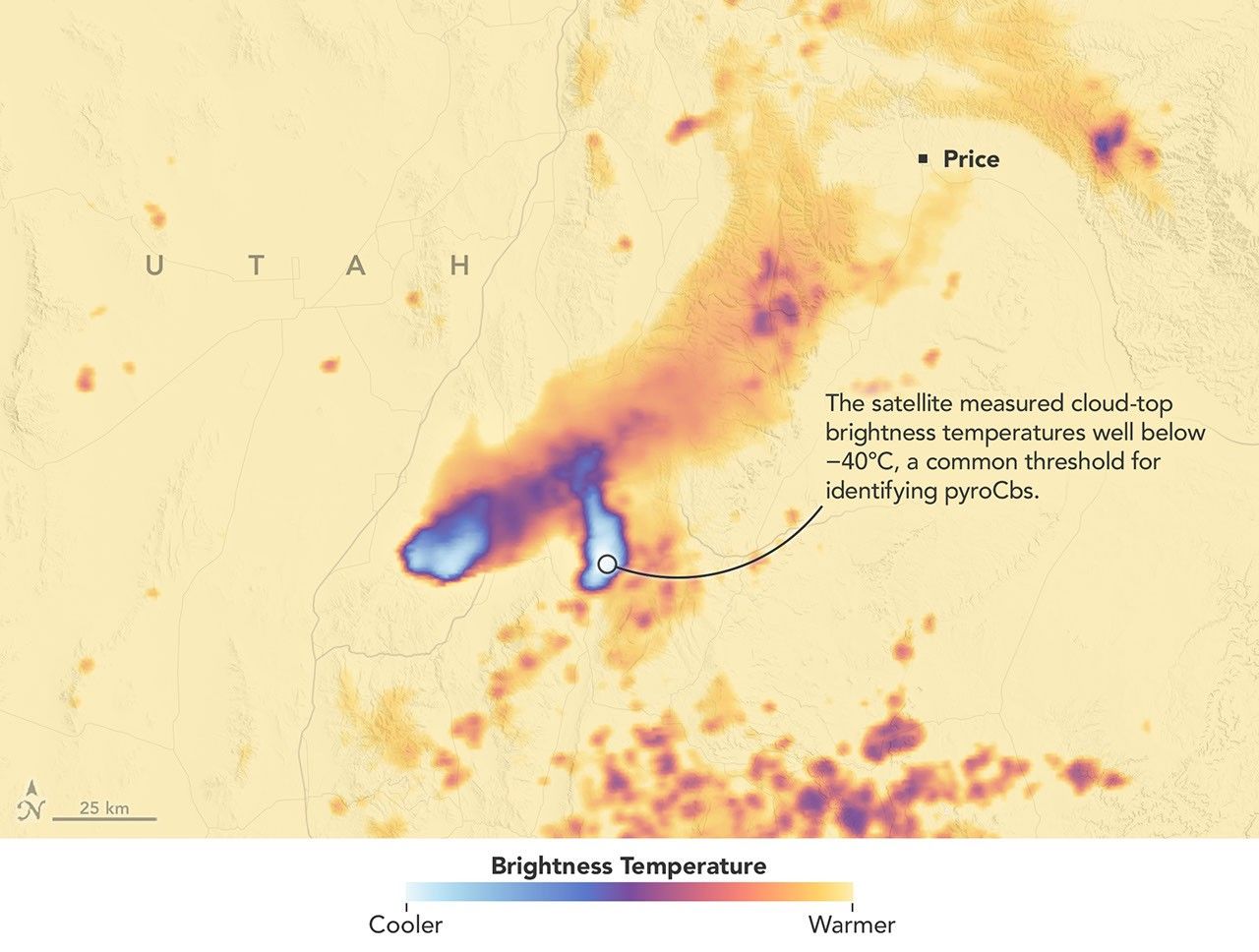
A smoke-infused pyrocumulonimbus (pyroCb) rises from the Widemouth 2 fire in Utah in these images captured by the MODIS (Moderate Resolution Imaging Spectroradiometer) on NASA's Aqua satellite. The left image is natural color; the right image is false color, revealing cloud-top brightness temperatures below -40°C, a commonly used threshold for identifying pyroCbs. NASA Earth Observatory images by Michala Garrison.
Scientists have long known that volcanoes can launch large quantities of particles into the stratosphere. In the past few decades, it has become clear that wildfires do this, too, by generating towering, smoke-infused pyrocumulonimbus (pyroCb) clouds.
The largest pyroCbs are stunning weather-making features that generate massive thunderheads capable of unleashing lightning, hail, and heavy rain. A growing body of research shows that pyroCbs can also leave an outsized imprint on the upper atmosphere by channeling pulses of particles and gases into the stratosphere's mostly dry, cloudless confines. Once there, smoke can spread widely and linger for months or years, sometimes circling the globe and likely influencing the ozone layer and Earth's energy budget.
Understanding these enigmatic and dangerous clouds is why a team of atmospheric scientists—part of a NASA mission called INSPYRE (INjected Smoke and PYRocumulonimbus Experiment)—is spending the summer chasing them with NASA's ER-2 aircraft, NSF/NCAR's GV, and a suite of truck-based sensors. The team completed one of its first sampling runs of the summer on August 3, 2026, when the GV flew through a high-altitude pulse of smoke from the Widemouth 2 fire, one of Utah's largest so far this year.
Lightning ignited the fire on July 27, 2026, but it remained relatively small until August 2, when it more than doubled in size amid intense winds and hot, dry conditions. That afternoon, soon after it had produced two pyroCb bursts, the MODIS (Moderate Resolution Imaging Spectroradiometer) on NASA's Aqua satellite captured this image (above), showing a chimney of high-altitude cloud and smoke casting a shadow on low-altitude smoke below.
These bursts propelled clouds high enough that Aqua measured cloud-top brightness temperatures well below −40°C, a common threshold for identifying pyroCbs and a sign that the cloud tops were bubbling to the top of the troposphere and sometimes into the stratosphere. The brightness temperature measurements "reveal two discrete pulses of pyroCb action," said Michael Fromm, a scientist at the U.S. Naval Research Laboratory. "The westernmost is the youngest pulse and stands out in the visible imagery by virtue of its shadow."
Though relatively routine and minor, this pyroCb event followed a pre-dawn pyroCb from the same fire, imaged by the NOAA weather satellite GOES-West. "Morning pyroCbs are much more unusual," Fromm said, because they don't benefit from daytime heating that helps fuel convection. In this case, however, there appeared to be enough atmospheric instability and water vapor in the air to allow for pyroCb development.
Multiple pyroCbs in a single day could have added unwanted complexity for forecasters and fire officials battling the blaze and organizing evacuations, said David Peterson, INSPYRE's principal investigator. "Minimizing that sort of uncertainty for fire forecasters is a big part of the reason we're out here studying this," he added.
Remote sensing experts like Peterson and Fromm routinely study pyroCbs from afar with satellites, but it's less common for pilots to chase and sample smoke plumes just hours after they form. In this case, the GV aircraft, on the ground in Colorado when the Widemouth 2 fire blew up, made a beeline for a high-altitude smoke plume as it drifted over New Mexico on August 3. The instruments on the plane sampled smoke at roughly 12 kilometers (8 miles) above the surface, collecting data at a height that isn't typically incorporated into forecast models.
A photo of the Widemouth 2 fire taken from an INSPYRE aircraft during a sampling flight on August 3, 2026, shows a smoke-infused cloud rising high above the fire.
Bernadett Weinzierl/University of Vienna
During that mission, a scientist on board captured this image (above) of a pyrocumulus (pyroCu) billowing up over the Widemouth 2 fire. While not as tall or energetic as pyroCbs, pyroCus are precursor clouds that share many of the same characteristics. Here, heat from the fire is fueling strong convective updrafts, forming a towering cloud with puffy overshooting tops that poke into the upper troposphere as lower-altitude smoke drifts below.
Satellites excel at identifying pyroCbs by measuring the temperature of the cloud tops that form above smoke plumes. Using this technique, researchers have established that wildfires produce about 70 pyroCbs per year, many in dense forests of Canada and Russia, though plenty also occur in grasslands and savannas in the United States and Australia. So far in 2026, Fromm and colleagues have identified at least 13 in the continental United States.
Since one of the first pyroCbs appeared in the scientific literature in the early 2000s, scientists have cataloged well over 700 events, and they now believe that wildfires may contribute up to 25 percent of the black carbon and organic aerosols in the lower stratosphere. The sheer frequency of pyroCbs means that the total mass of particles they inject over the course of a wildfire season may rival that of large volcanic eruptions.
Still, many questions about the enigmatic clouds remain unanswered. It isn't clear what vegetation is most likely to fuel pyroCbs, why some form more lightning than others, why they form in only a small fraction of fires, and how to accurately forecast them.
"Whether it be their dangerous manifestations on the ground or their long-lasting imprint on the upper troposphere and lower stratosphere," Fromm said, "pyroCbs continue to surprise us."
_NASA Earth Observatory images by Michala Garrison, using MODIS data from NASA EOSDIS LANCE and GIBS/Worldview. Photo by Bernadett Weinzierl/University of Vienna._ _Story by Adam Voiland._
Downloads
August 2, 2026: Natural Color
JPEG (1.63 MB)
Download August 2, 2026: Natural Color
August 2, 2026: Brightness Temperature
JPEG (1.07 MB)
Download August 2, 2026: Brightness Temperature
August 3, 2026
JPEG (319.28 KB)
References & Resources
- CIRA CSU, via Instagram (2026, August 3) Yesterday, the Widemouth 2 Fire in central Utah exploded. Accessed August 13, 2026.
- Denver 7, via Instagram (2026, July 28) Have you ever seen a smoke-filled cloud above a wildfire? Accessed August 13, 2026.
- _The Economist_ (2026, August 9) NASA takes aim at fire storms. Accessed August 13, 2026.
- Fromm, M., _et al._ (2022) Understanding the critical elements of the pyrocumulonimbus storm sparked by high-intensity wildland fire. _Communications Earth & Environment,_ 3, 243.
- InciWeb (2026) Widemouth 2 Fire. Accessed August 13, 2026.
- Katich, J.M. (2023) Pyrocumulonimbus affect average stratospheric aerosol composition. _Science,_ 379(6634), 815-820.
- NASA (2026) INSPYRE. Accessed August 13, 2026.
- NASA Jet Propulsion Laboratory (2026, July 20) New NASA Earth Missions Gear Up to Start Science Flights. Accessed August 13, 2026.
- NASA Airborne Science Program (2026) Earth Science Observation Platforms. Accessed August 13, 2026.
- NASA Earth Observatory (2021, July 30) A Summer of Fire-Breathing Smoke Storms. Accessed August 13, 2026.
- NASA Earth Observatory (2020, January 10) Explosive Fire Activity in Australia. Accessed August 13, 2026.
- Peterson, D., _et al._ (2025) Worldwide inventory reveals the frequency and variability of pyrocumulonimbus and stratospheric smoke plumes during 2013–2023. _Climate and Atmospheric Science,_ 8(325).
- The University of Utah (2026, August 6) Utah’s historic fire season of 2026. Accessed August 13, 2026.
- U.S. Naval Research Laboratory (2026, June 2) NRL Leads NASA Wildfire Research Mission to Better Predict Pyrocumulonimbus Storm Hazards. Accessed August 13, 2026.
- U.S. Naval Research Laboratory (2025, June 25) Fiery Storms: How Wildfires Create "Dirty Thunderstorms" and Impact Weather. Accessed August 13, 2026.
- The Weather Channel (2026, August 10) Meet the scientists who are flying into fire-breathing thunderstorms, and learn why they are doing it. Accessed August 13, 2026.
- Western Fire Chiefs (2026) Widemouth 2. Accessed August 13, 2026.
- World Meteorological Organization, Flammagenitus. Accessed August 13, 2026.
You may also be interested in:
Stay up-to-date with the latest content from NASA as we explore the universe and discover more about our home planet.

5 min read
The blaze burned more than 150 square miles and swept through parts of a ski resort.
Article

Ontario Wildfire Smoke Moves East
3 min read
Canadian wildfires sent plumes of smoke streaming over Ontario, Quebec, and parts of the U.S. Midwest and Northeast.
Article

Cascade Volcanoes Shrouded in Smoke
3 min read
From the International Space Station, astronauts photographed Mount Hood and Mount Rainier as wildfire smoke spread across the Pacific Northwest…
Article
Keep Exploring
Discover More from NASA Earth Science
Subscribe to Earth Observatory Newsletters \\
\\
Subscribe to the Earth Observatory and get the Earth in your inbox.\\
\\
 Earth Observatory Image of the Day \\
\\
NASA's Earth Observatory brings you the Earth, every day, with in-depth stories and stunning imagery.\\
\\
 Explore Earth Science\\
\\
 Earth Science Data \\
\\
Open access to NASA’s archive of Earth science data\\
\\

Δ
Did you find what you were looking for?(Required)
Yes
No
Partly
What were you looking for?(Required)
0 of 1000 max characters
What were you hoping to accomplish by visiting our website?(Required)
0 of 3000 max characters
×
Notifications