Chandra Deciphers Kinetic Collision in 'Treble Clef' Cluster
A massive galaxy cluster collision, resembling a treble clef, has been mapped in the X-ray spectrum by NASA’s Chandra Observatory, revealing the high-energy dynamics of cosmic structures.
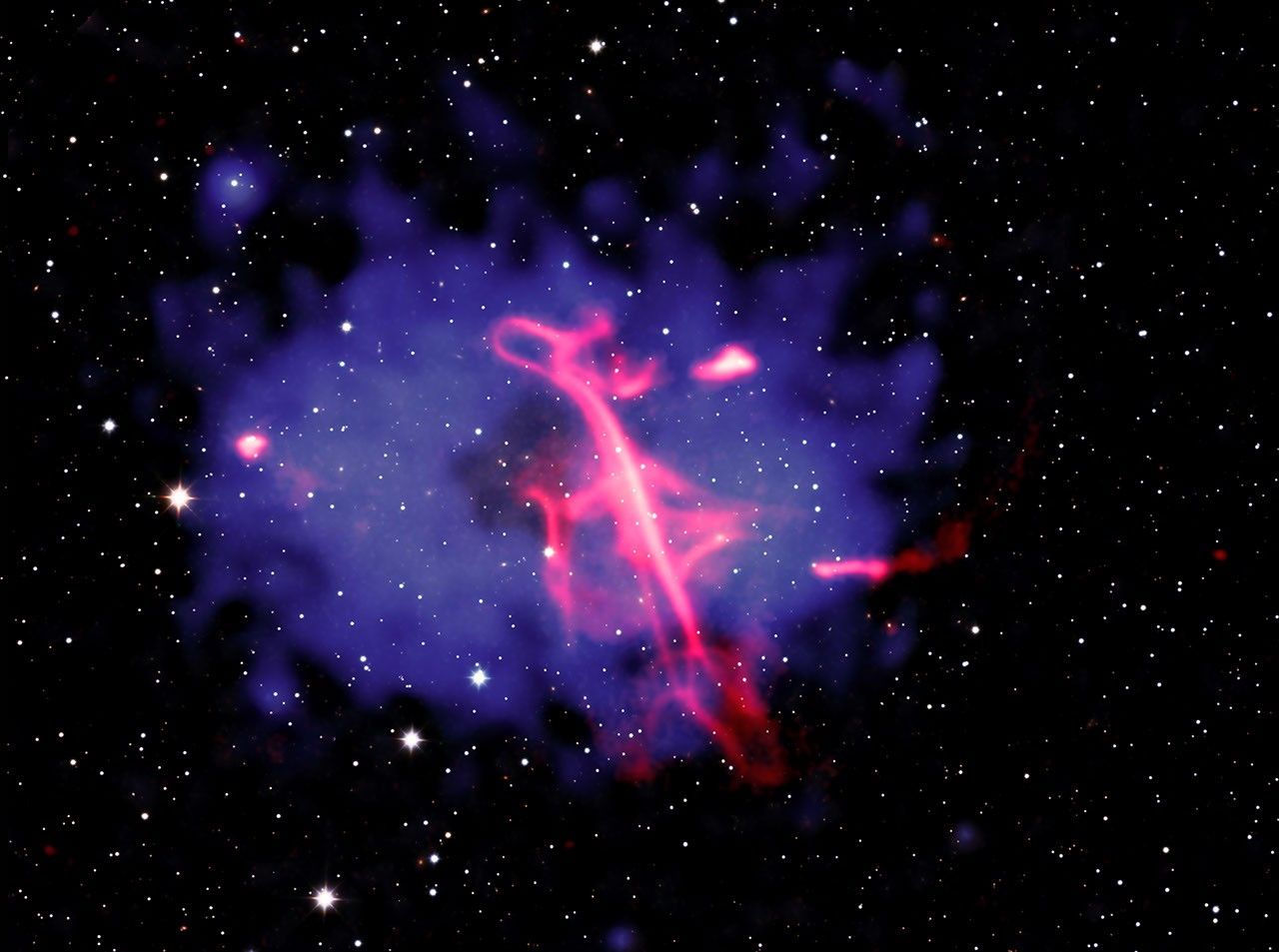
DATA INPUT: ABEL 1758
Deep-space surveillance has provided a new structural breakdown of a massive cosmic intersection. According to NASA Breaking News, the Chandra X-ray Observatory has mapped the high-energy dynamics of a complex galaxy cluster collision colloquially known as the 'Treble Clef' due to its distinct morphological signature.
SCAN ANALYSIS
Galaxy clusters represent the largest structures in the universe held together by gravity. They are not static; they are colossal laboratories of kinetic energy. The Treble Clef is actually a multi-stage impact site involving at least four separate galaxy clusters. Chandra’s X-ray data—rendered here in blue and purple—reveals clouds of multimillion-degree gas that permeate the space between individual galaxies.
Observations indicate two distinct pairs of clusters are currently in the process of merging. The 'northern' pair has already passed through one another, creating a bridge of superheated gas, while the 'southern' pair is in the early stages of gravitational engagement.
MULTI-WAVELENGTH VERIFICATION
To complete the picture, Chandra’s high-energy data was synthesized with optical scans from the Hubble Space Telescope (white and yellow) and radio data from the Very Large Array. The radio signatures detect vast regions of accelerated particles, a byproduct of the massive shockwaves generated by the collision. This data fusion allows researchers to calculate the velocity and mass distribution of the invisible dark matter driving the merger.
Total system mass is estimated in the quadrillions of solar masses, proving that even at a distance of billions of light-years, the physics of large-scale structure formation remains the primary engine of universal evolution.