Beta Pictoris: Webb Detects Aftermath of Massive Planetary Collision
New observations from the James Webb Space Telescope reveal a massive dust cloud in the Beta Pictoris system, evidence of a cataclysmic collision between giant planetesimals occurring just decades ago.
DATA FEED: ASTROPHYSICAL SCAN
Location: Beta Pictoris System
Status: Active Debris Field
Source: NASA Breaking News
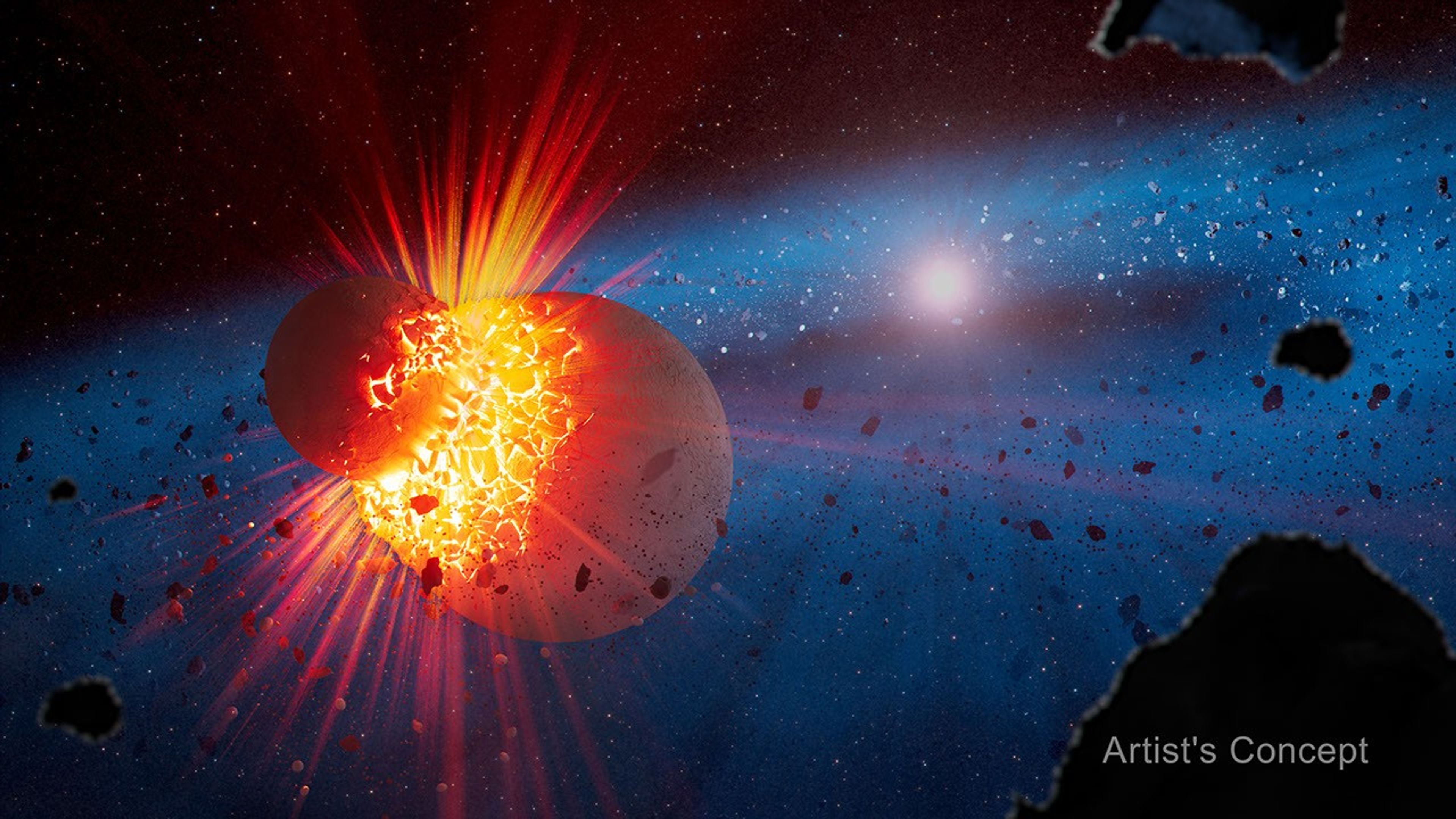
Recent telemetry from the James Webb Space Telescope (JWST) has identified a significant anomaly in the nearby Beta Pictoris system. Comparing new Mid-Infrared Instrument (MIRI) data with Spitzer Space Telescope observations from 2004, researchers have confirmed the disappearance of a massive dust signature. According to NASA Breaking News, this indicates a colossal planetary collision occurred shortly before the initial 2004 scans.
//The Impact Event
Astronomers led by Christine Chen of Johns Hopkins University suggest that two giant planetesimals—likely the size of Vesta—collided with extreme force. The impact pulverized the bodies, generating a massive cloud of fine, microscopic silicate dust. Over the past two decades, this debris has cooled and been expelled from the system by stellar radiation pressure, explaining the sudden drop in infrared luminosity detected by Webb.
//System Dynamics
Beta Pictoris is a youthful system, estimated at just 20 million years old. While it hosts two known gas giants, the presence of these debris clouds suggests a violent period of terrestrial planet formation is currently underway. The heat signature captured by Spitzer was the literal "smoking gun" of a world-shattering event, now fading as the dust disperses into the interstellar medium.
//Terminal Summary
This discovery provides a real-time observation of the chaotic processes that shaped our own solar system. By tracking the dissipation of these silicate clouds, scientists can better calculate the frequency of giant impacts in nascent star systems. The data confirms that planetary birth is not a peaceful process, but one defined by high-velocity kinetic destruction.