BepiColombo: MTM Selfie Array Archives Eight-Year Transit to Mercury
New long-term time-lapse data from the Mercury Transfer Module (MTM) documents BepiColombo's complex journey across the inner solar system, capturing the spacecraft's configuration and planetary flybys.
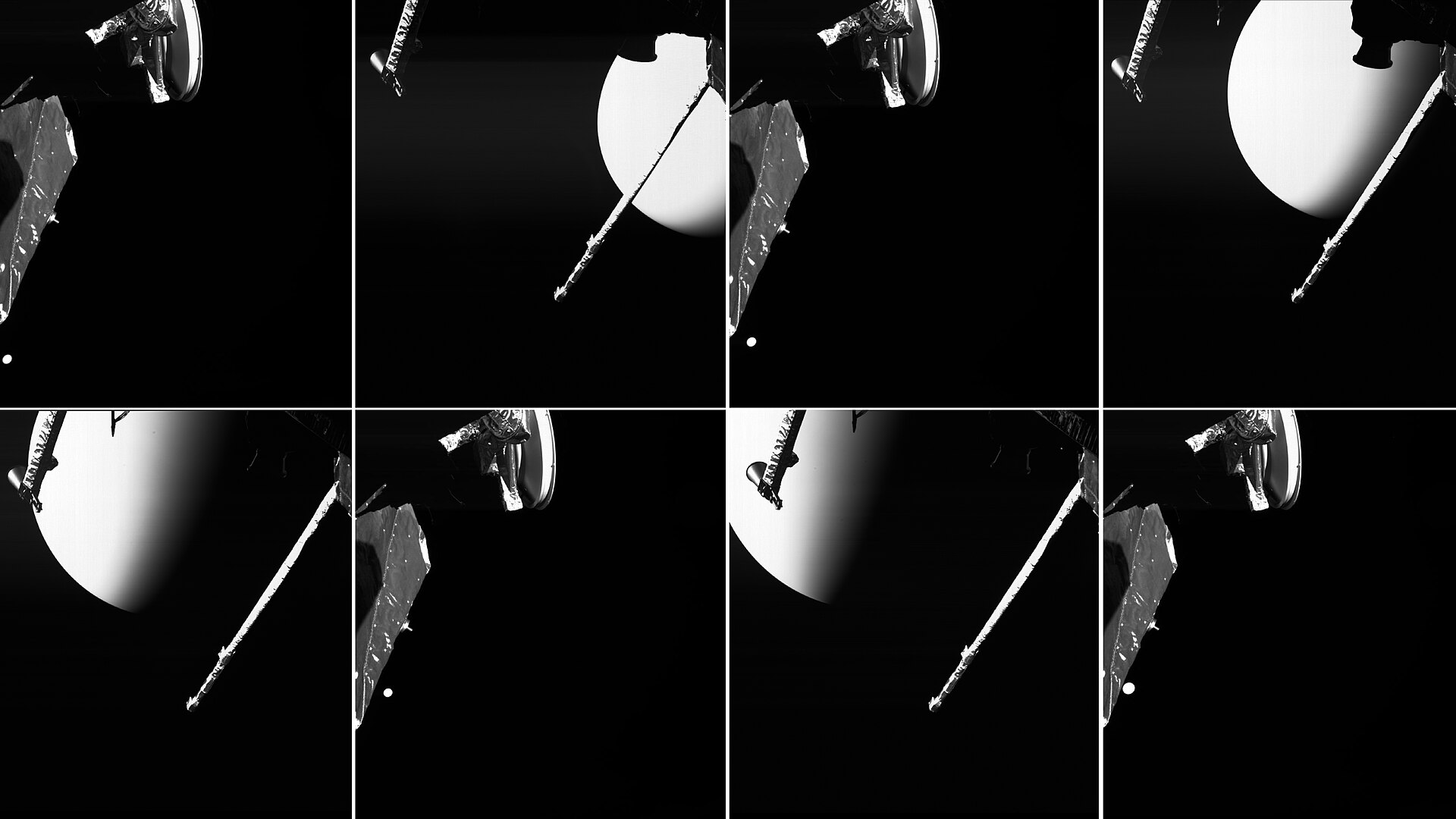
DATA ARCHIVE: MISSION PROGRESSION
The European Space Agency (ESA) has released processed visual telemetry from the Mercury Transfer Module (MTM), providing a definitive visual record of the BepiColombo mission’s eight-year outbound trajectory. According to ESA YouTube footage, the sequence utilizes a series of 'selfie' cameras integrated into the MTM to monitor structural integrity and deployment status during its high-radiation transit to the innermost planet.
TECHNICAL OVERVIEW
Launched in 2018, the BepiColombo stack—comprising the MTM, the Mercury Planetary Orbiter (MPO), and the Mercury Magnetospheric Orbiter (Mio)—relies on a series of complex gravity assists. The MTM’s monitoring cameras (MCAMs) provide black-and-white snapshots that serve dual purposes: engineering diagnostics and navigational context. The footage archives the deployment of solar arrays and high-gain antennas, set against the backdrop of Earth, the Moon, Venus, and Mercury itself during successive flybys.
MISSION VECTOR
The imagery underscores the technical difficulty of the mission's 'braking' maneuver. To achieve orbital insertion, the spacecraft must shed significant orbital energy while resisting the Sun's immense gravitational pull. The MTM is scheduled for disposal in late 2025, shortly before the two science orbiters separate to begin their independent observations. This visual log stands as a final testament to the module that facilitated the most challenging inner-system journey in ESA's history.