BEPICOLOMBO INITIATES FINAL MERCURY ORBITAL INSERTION
The ESA/JAXA BepiColombo mission has entered its terminal approach phase for Mercury, commencing a series of complex gravity assists to achieve stable orbit around the solar system's innermost planet.
MISSION UPDATE: B0-2024-M
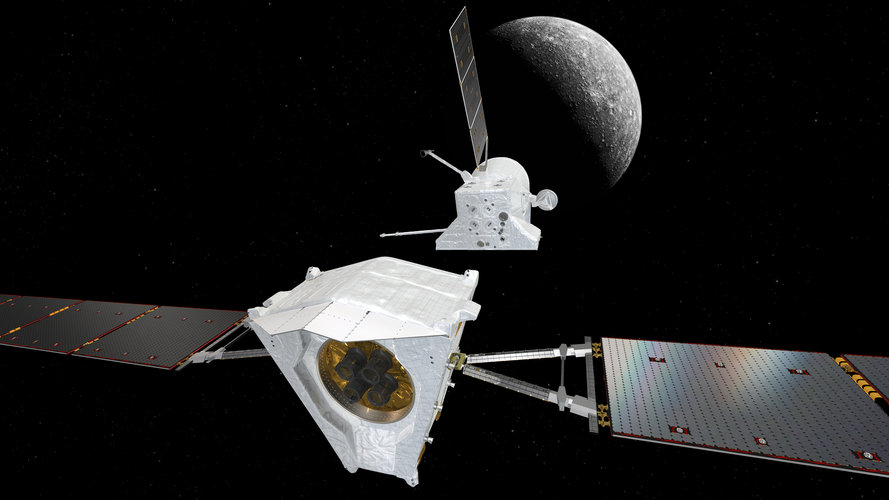
The joint European-Japanese mission, BepiColombo, has officially commenced its final arrival sequence at Mercury. According to the European Space Agency (ESA), the spacecraft is now transitioning from its long-duration cruise phase into the critical orbital insertion maneuvers required to study the sun-scorched terrestrial world.
ORBITAL MECHANICS
Navigating the intense gravitational well of the Sun requires a sophisticated series of planetary flybys. BepiColombo utilizes gravity assist maneuvers to shed excess orbital energy, allowing it to eventually be captured by Mercury’s weak gravity. This complex ballet involves two separate orbiters—the Mercury Planetary Orbiter (MPO) and the Mercury Magnetospheric Orbiter (MMO)—currently traveling together as a single composite stack.
DATA AND OPERATIONS
Real-time monitoring is currently underway at the European Space Operations Centre (ESOC) in Darmstadt, Germany. ESA mission controllers are overseeing the vessel’s telemetry as it approaches the planet. The mission aims to resolve long-standing questions regarding Mercury’s internal structure, magnetic field, and the composition of its thin exosphere.
SCIENTIFIC OBJECTIVES
Once the transition is complete, the two orbiters will decouple to begin their distinct scientific agendas. The MPO, led by ESA, will focus on surface mapping and internal composition, while JAXA’s MMO will investigate the planet’s interaction with solar wind. This arrival marks a significant milestone for European deep-space exploration, representing one of the most challenging ballistics profiles ever attempted by the agency.