BepiColombo: Eight-Year Deep Space Journey Logged via MTM Monitoring Cameras
According to ESA, the Mercury Transfer Module (MTM) has documented its long-duration cruise to the innermost planet, releasing a time-lapse of its eight-year deep space odyssey.
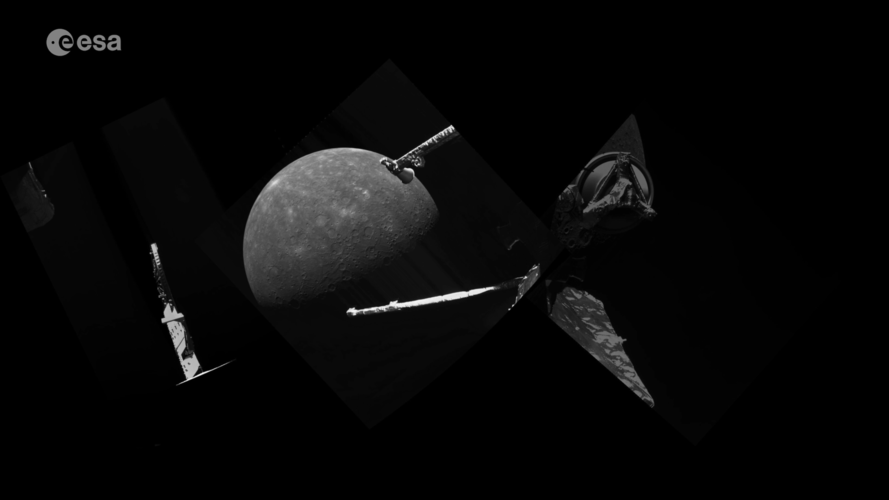
DATA LOG: CRUISE PHASE TERMINATION
The Mercury Transfer Module (MTM), a critical component of the joint ESA-JAXA BepiColombo mission, has provided a visual record of its eight-year journey through the inner solar system. According to ESA, the spacecraft utilized its suite of onboard monitoring cameras to capture "selfie" footage, documenting the mission’s complex trajectory toward Mercury.
SYSTEM OVERVIEW: MONITORING CAMERAS
The MTM is equipped with three monitoring cameras (M-CAMs) that have served as the mission's eyes during its long-duration cruise. These sensors were not designed for high-resolution scientific imaging, but rather for engineering verification. They have consistently monitored the deployment and health of the spacecraft's 15-meter-long solar arrays and high-gain antennas.
Throughout the transit, these cameras captured the silent mechanics of deep space travel, including planetary flybys of Earth, Venus, and Mercury itself. The footage serves as a technical testament to the durability of European hardware in high-radiation environments. According to ESA, the compilation highlights the mission's progression since its 2018 launch, showcasing the structural integrity of the composite spacecraft.
MISSION STATUS
BepiColombo is currently executing a series of gravity-assist maneuvers required to shed orbital energy. This allows the craft to be captured by Mercury's gravity—a feat that requires extreme precision. The MTM will eventually separate from the two science orbiters, the Mercury Planetary Orbiter (MPO) and the Mercury Magnetospheric Orbiter (Mio), once the final orbital insertion is achieved. The visual data provided by the MTM ensures ground teams can verify the mechanical configuration of the stack before the primary science phase begins.