Avio Solidifies 2026 Flight Cadence with Sentinel-3 and FLEX Deployment
Avio's Vega-C rocket successfully completed its second mission of 2026, launching the Sentinel-3 Earth observation satellite and ESA’s FLEX mission from French Guiana.
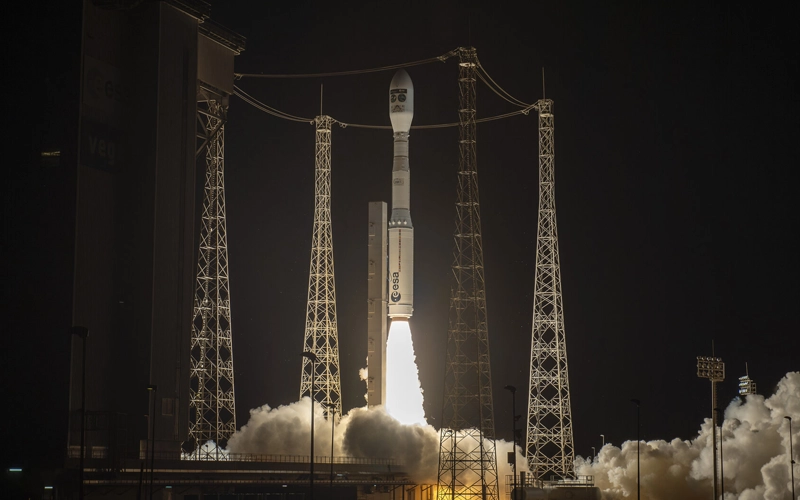
Mission Protocol: VV28 Success
Italian launch services provider Avio has confirmed the successful deployment of the VV28 mission, marking the second operational flight for the Vega-C launch vehicle in 2026. The rocket departed from the Guiana Space Centre at 01:21 UTC, executing a nominal ascent to deliver a dual-payload manifest into orbit.
Payload Specifications
According to European Spaceflight, the mission primary objective was the delivery of the European Commission’s third Sentinel-3 Earth observation satellite. This unit is a critical component of the Copernicus program, designed to provide high-precision optical, radar, and altimetry data for maritime and terrestrial monitoring.
Sharing the ride was the European Space Agency’s (ESA) FLEX (Fluorescence Explorer) mission. FLEX is a specialized scientific instrument designed to map global vegetation health by detecting the faint fluorescence emitted by plants during photosynthesis. This data is expected to provide unprecedented insights into the terrestrial carbon cycle.
Strategic Trajectory
This launch signifies a stabilizing flight cadence for Avio following the vehicle's return-to-flight phase. The successful separation of both satellites into their target sun-synchronous orbits demonstrates the Vega-C’s capability to handle complex, multi-payload orbital insertions. For the European space sector, the reliable operation of Vega-C remains essential for maintaining autonomous access to space for medium-class payloads.
Avio continues to streamline its 2026 manifest as it looks toward high-frequency operations at the Kourou spaceport.