Atmospheric Discharges and Rapid Deployment: China Rockets Through 51st Launch of Year
A Long March 3B survived a direct lightning strike to deliver its payload, while a Kinetica-1 solid rocket successfully deployed five satellites as China nears its 100-launch annual goal.
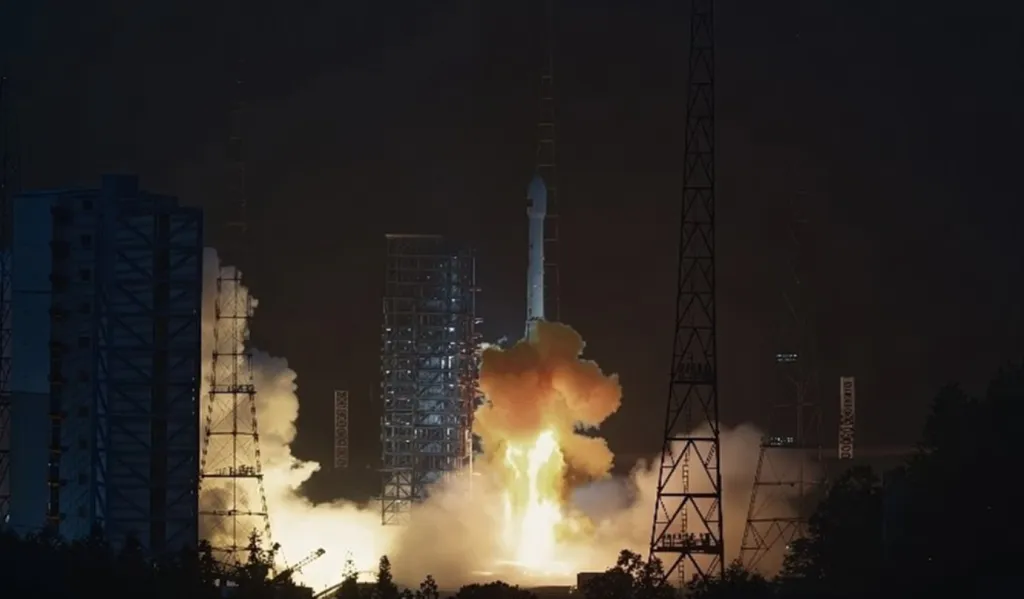
Lightning Encounter Over Xichang
On July 23, a Long March 3B heavy-lift vehicle successfully delivered the Tianlian-2 (06) relay satellite to geostationary transfer orbit despite a severe atmospheric electrical discharge. According to SpaceNews, amateur footage confirmed a direct lightning strike approximately 30 seconds post-liftoff from the Xichang Satellite Launch Center. While China Aerospace Science and Technology Corporation (CASC) declared the mission a total success, the event mirrors historic anomalies such as the Apollo 12 and Soyuz-2 strikes. The Tianlian-2 constellation is critical infrastructure, providing telemetry and communications for China’s Tiangong space station.
Kinetica-1 Rideshare Deployment
Hours later, at 19:33 ET, a Kinetica-1 (Lijian-1) solid rocket launched from the Jiuquan spaceport. This commercial mission successfully deployed five distinct payloads into orbit:
- Chenguang-1: A space computing platform from Spacety.
- Gande-1 (01): China’s first commercial debris monitoring satellite.
- Xiguang-2 (03): A high-resolution infrared sensing platform.
- Jitianxing A-04: An intelligent computing satellite.
- Yinglong Fengguang-1: A meteorological sounder.
Operational Tempo
These missions represent China’s 50th and 51st launches of 2026. CAS Space has communicated intentions to maintain a monthly launch cadence through the second half of the year. The nation is currently on track to attempt over 100 orbital launches within a single calendar year, a milestone that underscores the industrialization of the Chinese launch sector and its hardening against environmental variables like adverse weather.