Arctic Impact: PII-2012 Ice Island Collides with Joe Island
A massive iceberg spawned from Greenland's Petermann Glacier has survived a direct collision with Joe Island, maintaining its structural integrity as it drifts into the Nares Strait.
Orbital Surveillance Report
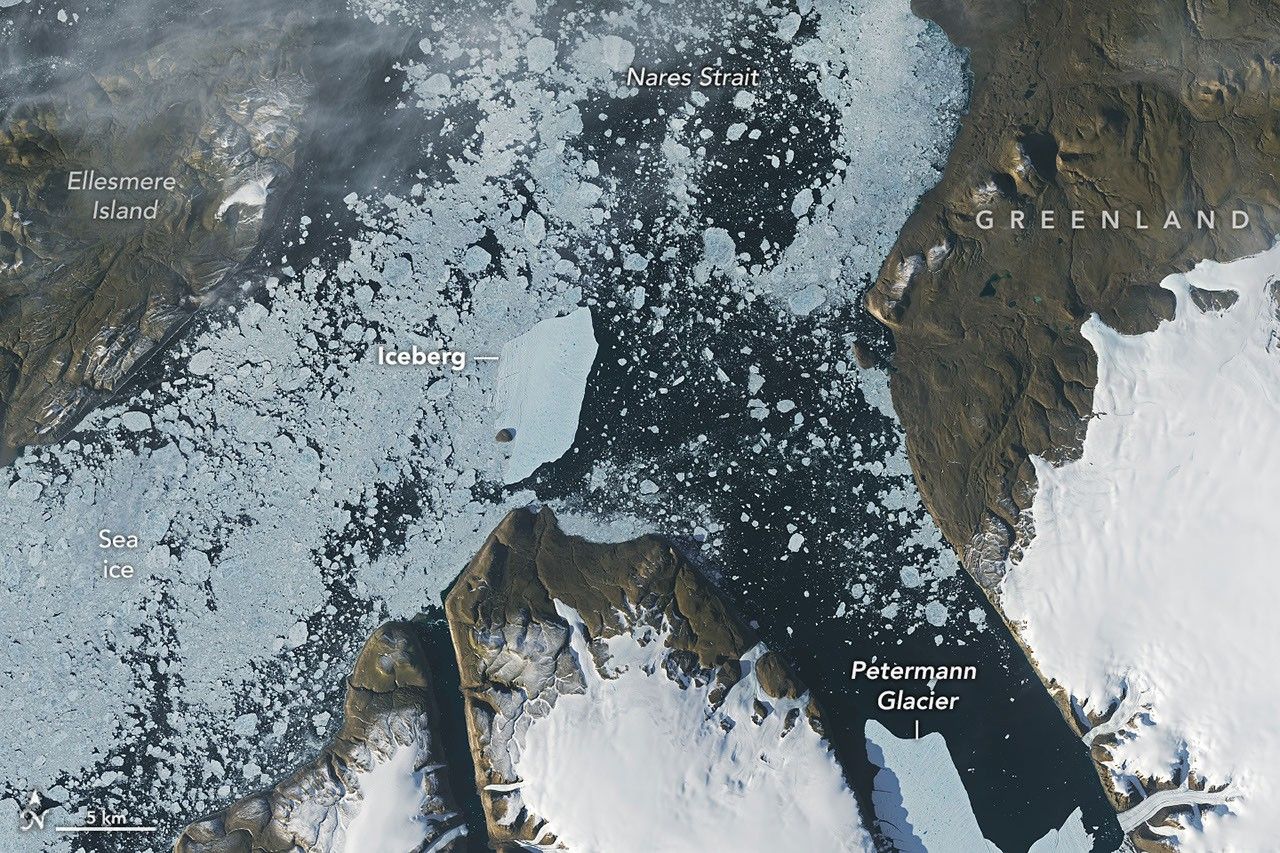
Satellite telemetry confirms that a massive ice island, designated PII-2012, has successfully navigated a high-stakes encounter with Joe Island in the Nares Strait. The iceberg, a significant fragment calved from Greenland’s Petermann Glacier in July 2012, was initially expected to undergo catastrophic fragmentation upon impact.
According to NASA Breaking News, the collision occurred as PII-2012 drifted southward through the narrow channel separating Greenland and Ellesmere Island. The Moderate Resolution Imaging Spectroradiometer (MODIS) on NASA’s Aqua and Terra satellites captured the sequence over several days. Despite the kinetic energy of the impact, the ice island remained largely intact. Post-collision analysis shows PII-2012 has cleared the stationary Joe Island and continues its trajectory toward the Labrador Sea.
Tactical Assessment
Joe Island, a small, rocky landmass, acted as a stationary pylon during the event. While the ice island suffered minor peripheral calving, its core mass—estimated at approximately 130 square kilometers—survived. This event highlights the extreme structural resilience of massive tabular icebergs formed by the Petermann Glacier's recurring calving cycles.
The trajectory of PII-2012 is being closely monitored by orbital assets. Its movement into the Nares Strait represents a standard, yet significant, flux in Arctic maritime conditions. Further fragmentation is anticipated as the island enters warmer southern currents, potentially creating smaller hazards for regional shipping lanes.