Arctic Cryosphere Transition: Melt Season Volatility Stabilizes
Satellite telemetry indicates the rapid expansion of the Arctic melt season has decelerated since 2005. Despite an overall increase of 20 days since 1979, the rate of change is reaching a new equilibrium.
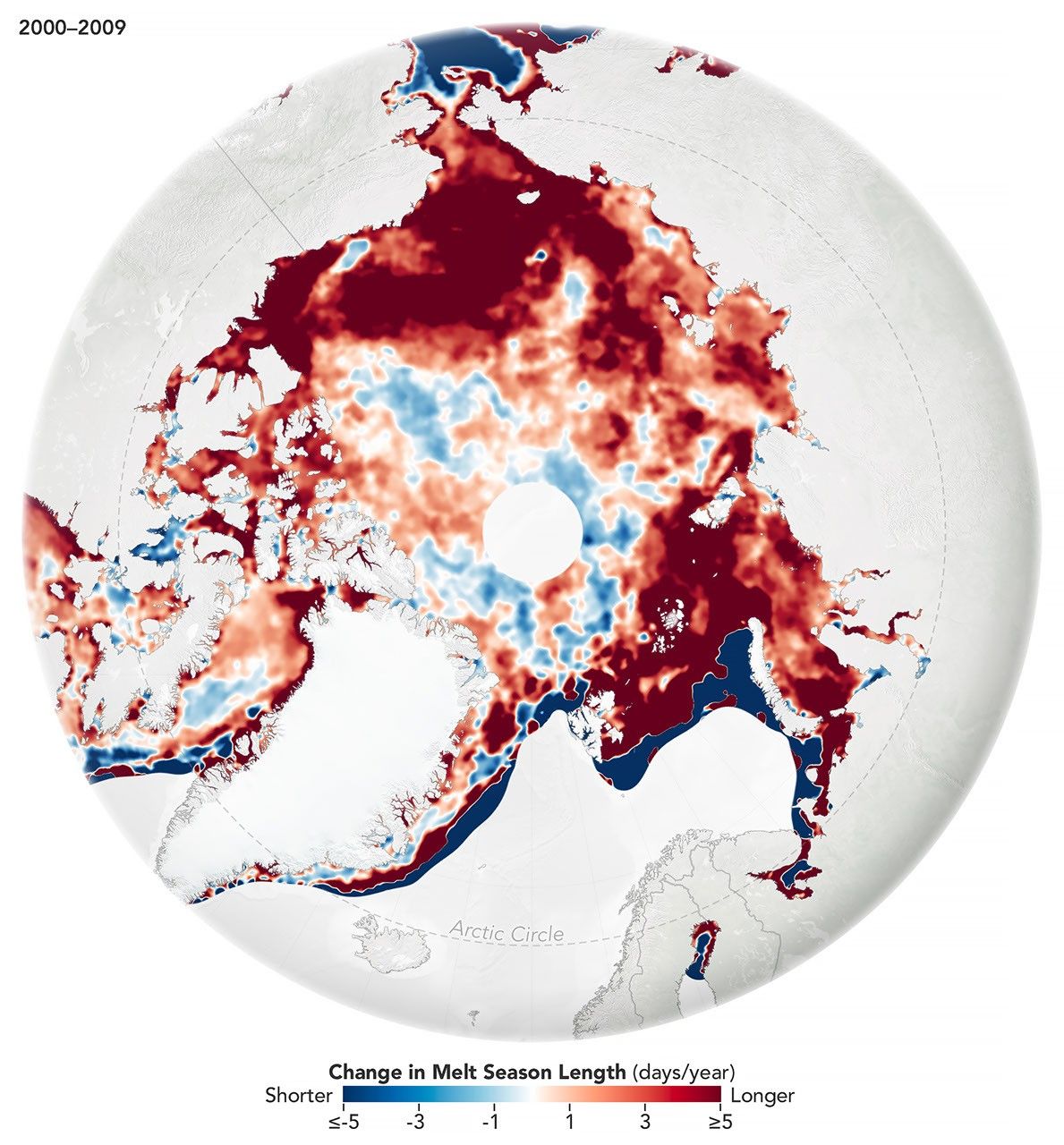
Data Analysis: Orbital Telemetry
Recent analysis of long-term satellite observations reveals a shift in the thermal dynamics of the Arctic. According to NASA Breaking News, the duration of the annual melt season—the window when sea ice undergoes significant liquid phase transitions—has ceased its aggressive expansion. While the total melt duration has extended by an average of 20 days since 1979, data indicates the rate of this growth has leveled off since 2005.
Seasonal Benchmarks
The Arctic melt cycle is defined by two critical inflection points: the initial surface thaw in spring and the commencement of refreezing in autumn. The recorded 20-day expansion is primarily attributed to a combination of earlier spring thaws and significantly delayed autumn freeze-ups. Between 1979 and 2005, the melt season lengthened at a rate of roughly 6.5 days per decade.
Current Trajectory
Post-2005, the data suggests a plateau. Although the Arctic remains significantly warmer than the pre-satellite era, the year-to-year variability has stabilized. Researchers note that while the season is not currently continuing to lengthen at its previous velocity, the current baseline represents a radically different cryospheric environment than the 20th-century norm. The stabilization suggests the system may have reached a temporary equilibrium under current atmospheric conditions, though the loss of multi-year ice volume remains a critical concern for orbital monitoring missions.