An Uncommon Drifter in the Denmark Strait
A large iceberg, observed in summer 2026, had drifted more than 1,000 kilometers south from the northeastern Greenland bay where it likely originated.
Search
Suggested Searches
- Climate Change
- Artemis
- Expedition 64
- Mars perseverance
- SpaceX Crew-2
- International Space Station
- View All Topics A-Z
- Home
- Missions
- Humans in Space
- Earth
- The Solar System
- The Universe
- Science
- Aeronautics
- Technology
- Learning Resources
- About NASA
- Español
Highlights
  
Back
- Search All NASA Missions
- A to Z List of Missions
- Upcoming Launches and Landings
- Spaceships and Rockets
- Communicating with Missions
- Artemis
- James Webb Space Telescope
- Hubble Space Telescope
- International Space Station
- OSIRIS-REx
- Explore Earth Science
- Climate Change
- Earth, Our Planet
- Earth Science in Action
- Earth Multimedia
- Earth Data
- Earth Science Researchers
- The Sun
- Mercury
- Venus
- Earth
- The Moon
- Mars
- Jupiter
- Saturn
- Uranus
- Neptune
- Pluto & Dwarf Planets
- Asteroids, Comets & Meteors
- The Kuiper Belt
- The Oort Cloud
- Skywatching
- Exoplanets
- The Search for Life in the Universe
- Stars
- Galaxies
- Black Holes
- The Big Bang
- Dark Matter
- Dark Energy
- Earth Science
- Planetary Science
- Astrophysics & Space Science
- The Sun & Heliophysics
- Biological & Physical Sciences
- Lunar Science
- Citizen Science
- Astromaterials
- Aeronautics Research
- Human Space Travel Research
- Science in the Air
- NASA Aircraft
- Flight Innovation
- Supersonic Flight
- Air Traffic Solutions
- Green Aviation Tech
- Drones & You
- Technology Transfer & Spinoffs
- Space Travel Technology
- Technology Living in Space
- Manufacturing and Materials
- Robotics
- Science Instruments
- Computing
- For Kids and Students
- For Educators
- For Colleges and Universities
- For Professionals
- Science for Everyone
- Requests for Exhibits, Artifacts, or Speakers
- STEM Engagement at NASA
- NASA's Impacts
- Centers and Facilities
- Directorates
- Organizations
- People of NASA
- Careers
- Internships
- Our History
- Doing Business with NASA
- Get Involved
- Contact
- NASA+
- Images
- NASA Live
- NASA Apps
- Podcasts
- Image of the Day
- e-Books
- 3D Resources
- Interactives
- STEM Multimedia
- NASA Brand & Usage Guidelines
Highlights
  
Highlights
  
Highlights
  
Highlights
  
Highlights
  
Highlights
  
Highlights
  
Highlights
  
Highlights

Highlights
  
Highlights
  
Earth Observatory
4 min read
# An Uncommon Drifter in the Denmark Strait
Image of the Day for August 20, 2026
A large iceberg, observed in summer 2026, had drifted more than 1,000 kilometers south from the northeastern Greenland bay where it likely originated.
NASA Earth Observatory
Aug 20, 2026
Article

View more Images of the Day:

Instruments:
Topics:
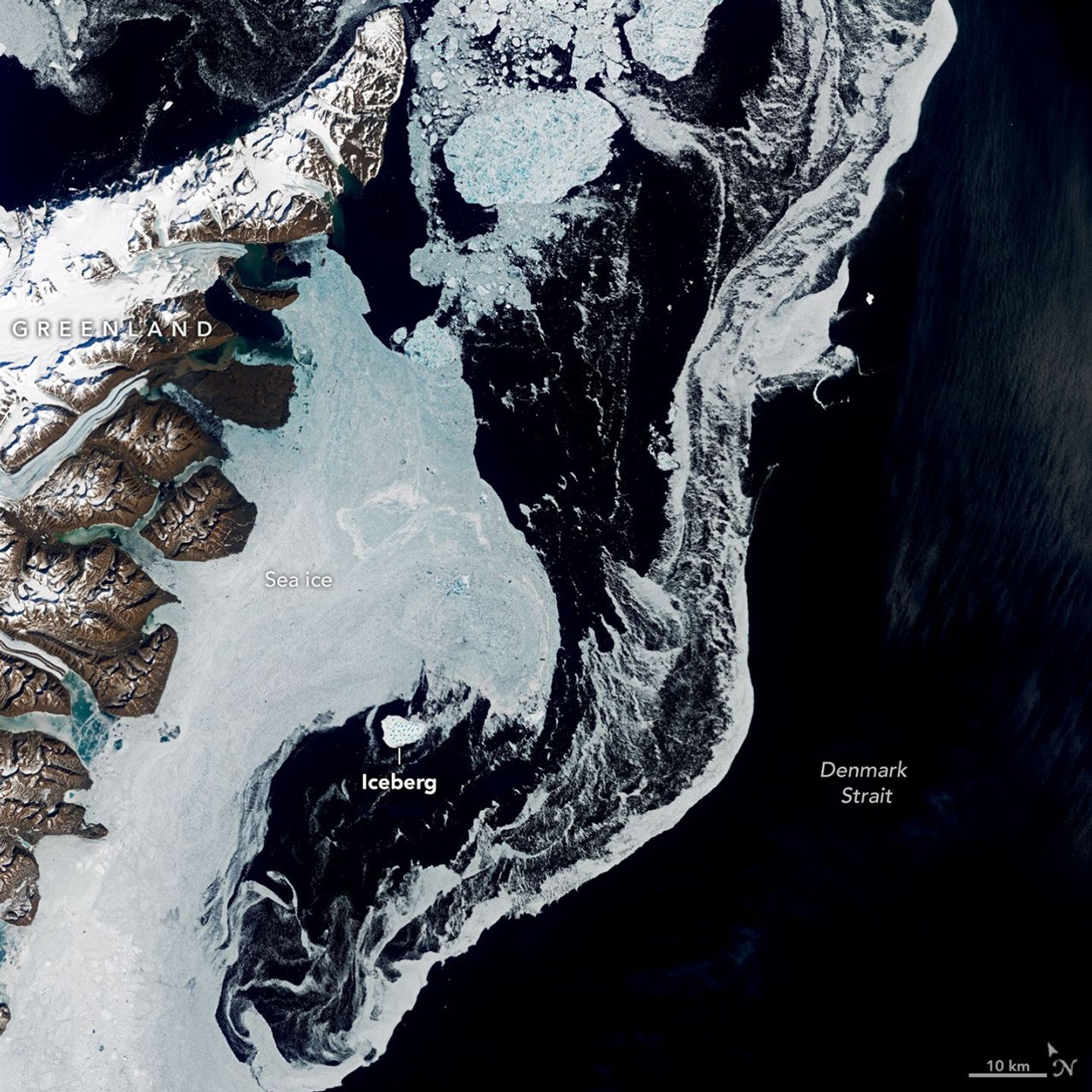
An iceberg drifts through the Denmark Strait in this image acquired on June 12, 2026, by the OLI (Operational Land Imager) on Landsat 9.
NASA Earth Observatory/Lauren Dauphin
Greenland’s jagged coastline is lined with fjords, many of them cradling marine-terminating glaciers that routinely calve icebergs into the water. It’s common to see these bergs, small and large, drifting in the island’s fjords each summer once the sea ice breaks up. In summer 2026, one exceptionally large berg turned up in the Denmark Strait—more than a thousand kilometers south of where it apparently originated.
These images, captured by the OLI (Operational Land Imager) on Landsat 9, show the iceberg on June 12 as it drifted in the strait between Greenland and Iceland. It was just south of Kangikajiip Appalia, a cape on Greenland’s east coast visible in the scene’s upper left, amid a mixture of sea ice and berg fragments known as “mélange.”
Alexis Denton, oceanographer and chief scientist with the International Ice Patrol, noted that several clues indicate it is an iceberg rather than thick, multi-year sea ice: its proximity to shore, its whiter color, and larger size compared to the surrounding sea ice. Measuring roughly 17 square kilometers (7 square miles) on June 12, the iceberg was about five times the area of New York City's Central Park. That’s modest compared to the behemoth bergs that calve from Antarctic glaciers and ice shelves but large by Greenland standards.
Keld Quistgaard, a senior ice advisor with the Danish Meteorological Institute’s Greenland Ice Service, noted that it originated in Jøkelbugten—a bay in northeastern Greenland. The berg’s precise origin within that bay, however, remains something of a mystery. It’s possible that the berg broke off from Zachariæ Isstrøm or its adjacent remnant ice shelf. The ice shelf, which together with Zachariæ Isstrøm once filled the bay, was abandoned after the glacier rapidly retreated in the early 2000s.
Tracing its path back through satellite imagery is challenging. Through spring, the bay and surrounding coastal areas are choked with sea ice and berg fragments, making individual bergs hard to distinguish, especially if covered in bright snow. In late May, for instance, the berg was surrounded by numerous look-alikes. Only later in the season, as it drifted farther south and the ice around it thinned out, did it become distinct enough to easily spot.
The iceberg's bright white surface is pocked with light blue meltwater ponds in this detailed view of the image, acquired on June 12, 2026, by the OLI (Operational Land Imager) on Landsat 9.
NASA Earth Observatory/Lauren Dauphin
Its size and striking network of blue meltwater ponds offer some clues to its origin, according to Christopher Shuman, a retired University of Maryland glaciologist. Shuman thinks the berg broke from the remnant ice shelf rather than the glacier itself. Bergs calved from Zachariæ Isstrøm tend to be smaller, he said. Also, the berg’s surface—pocked with meltwater ponds, "like Swiss cheese"—closely resembles the remnant shelf ice. Past satellite images show pieces of that shelf ice drifting south and getting trapped among islands bordering the bay, where winds and tides have jostled them for years.
As of mid-August, the berg was about 1,500 kilometers (900 miles) from the bay, drifting south on the Greenland Coastal Current into the North Atlantic. Quistgaard expected the iceberg to gradually disintegrate throughout the month. Recent satellite imagery suggested it was doing just that.
Breaking up in the Denmark Strait means that remnants of the berg are unlikely to drift into busier shipping lanes that go past the southern tip of Greenland. “Its journey is a reminder of the dynamic Earth,” Shuman said, “as well as the seasonal variability of the ice in this part of the North Atlantic.”
_NASA Earth Observatory images by Lauren Dauphin, using Landsat data from the_ _U.S. Geological Survey_ _._ _Story by Kathryn Hansen._
Downloads
June 12, 2026
JPEG (16.74 MB)
References & Resources
- NASA Earth Observatory (2015, December 4) Zachariæ Isstrøm Glacier, Greenland. Accessed August 19, 2026.
- Sutherland, D. A., and Pickart, R. S. (2008). The East Greenland Coastal Current: Structure, variability, and forcin g. _Progress in Oceanography_, 78(1), 58-77.
You may also be interested in:
Stay up-to-date with the latest content from NASA as we explore the universe and discover more about our home planet.

Record-Setting Retreat of Hektoria Glacier
5 min read
Scientists relied on satellite data to understand how the Antarctic glacier lost so much ice so rapidly.
Article

A Bare Summer for Barnes Ice Cap
4 min read
The expanse of glacial ice on Canada’s Baffin Island lost its snow cover quickly and early in summer 2026, revealing…
Article

Pink Penguin Guano Provides Diet Clues
3 min read
The color of Adélie penguin droppings reveals what the birds are eating, offering scientists a way to track how sea…
Article
Keep Exploring
Discover More from NASA Earth Science
Subscribe to Earth Observatory Newsletters \\
\\
Subscribe to the Earth Observatory and get the Earth in your inbox.\\
\\
 Earth Observatory Image of the Day \\
\\
NASA's Earth Observatory brings you the Earth, every day, with in-depth stories and stunning imagery.\\
\\
 Explore Earth Science\\
\\
 Earth Science Data \\
\\
Open access to NASA’s archive of Earth science data\\
\\

Δ
Did you find what you were looking for?(Required)
Yes
No
Partly
What were you looking for?(Required)
0 of 1000 max characters
What were you hoping to accomplish by visiting our website?(Required)
0 of 3000 max characters
×
Notifications