A look back at the 2026 total solar eclipse
On 12 August 2026, Europe witnessed the first total solar eclipse in over two decades. Millions of people were awed by the Moon completely covering the Sun's bright disc, briefly turning day into night and revealing the Sun's outer atmosphere. Totality could be seen from Greenlan
We use cookies which are essential for you to access our website and/or to provide you with our services, enable you to share our website content via your social media accounts and allow us to measure and improve the performance of our website.
Accept all cookies Accept only essential cookies See our Cookie Notice
!ESA menu toggle!ESA search toggle!ESA title

About ESA
The European Space Agency (ESA) is Europe’s gateway to space. Its mission is to shape the development of Europe’s space capability and ensure that investment in space continues to deliver benefits to the citizens of Europe and the world.
Highlights
Careers \\
\\
 Business with ESA\\
\\
 Newsroom\\
\\
 Education\\
\\
 Kids\\
\\
 ESA Space Shop\\
\\

ESA - United space in Europe
This is ESA ESA facts Member States & Cooperating States Funding Director General Top management For Member State Delegations European vision European Space Policy ESA & EU Space Councils Responsibility & Sustainability Annual Report Calendar of meetings Corporate news
Establishments & sites
ESA Headquarters ESA ESTEC ESA ESOC ESA ESRIN ESA EAC ESA ESAC Europe's Spaceport ESA ESEC ESA ECSAT Brussels Office Washington Office
Working with ESA
Business with ESA ESA Commercialisation Gateway Law at ESA Careers Cyber resilience at ESA IT at ESA Newsroom Partnerships Merchandising Licence Education Open Space Innovation Platform Integrity and Reporting Administrative Tribunal Health and Safety
More about ESA
History ESA Historical Archives Exhibitions Publications Art & Culture ESA Merchandise Kids Diversity ESA Brand Centre
Latest
Story\\
\\

Focus on\\
\\

Press ReleaseN° 5–2026\\
\\
Open
Space in Member States
Find out more about space activities in our 23 Member States, and understand how ESA works together with their national agencies, institutions and organisations.
                      
Science & Exploration
Exploring our Solar System and unlocking the secrets of the Universe
Programmes
Space Science Human and Robotic Exploration
Astronauts
Sophie Adenot\\
\\
 Pablo Álvarez Fernández\\
\\
 Rosemary Coogan\\
\\
 Samantha Cristoforetti\\
\\
 Alexander Gerst\\
\\
 Raphaël Liégeois\\
\\
 Matthias Maurer\\
\\
 Andreas Mogensen\\
\\
 Luca Parmitano\\
\\
 Thomas Pesquet\\
\\
 Marco Sieber\\
\\

Missions
Juice Euclid Webb Solar Orbiter BepiColombo Gaia ExoMars Cheops Exoplanet missions More missions
Activities
International Space Station Orion service module Gateway Concordia Caves & Pangaea Benefits/videos)
Latest
Story\\
\\

Press ReleaseN° 49–2024\\
\\
Open
Focus on\\
\\

Space Safety
Protecting life and infrastructure on Earth and in orbit
About space safety
Protecting our Pale Blue Dot Space Safety at ESA
Asteroids
Asteroids and Planetary Defence Asteroid danger explained Flyeye telescope: asteroid detection Hera mission: asteroid deflection Near-Earth Object Coordination Centre
Space junk
About space debris Space debris by the numbers Space Environment Report In space refuelling, refurbishing and removing
Safety from space
Clean Space Ecodesign Zero Debris Technologies Space for Earth Supporting Sustainable Development
Space weather
Space weather and its hazards ESA Vigil: providing solar warning ESA Space Weather Service Network
Latest
Story\\
\\

Focus on\\
\\

Applications
Using space to benefit citizens and meet future challenges on Earth
Observing the Earth
Observing the Earth Future EO Copernicus Meteorology Space for our climate Satellite missions
Connectivity
Connectivity and Secure Communications ARTES Moonlight Civil security from space
Satellite navigation
Satellite navigation Galileo EGNOS NAVISP Genesis Celeste
Commercialisation
ESA Commercialisation Gateway Open Space Innovation Platform Business Incubation ESA Space Solutions
Latest
Story\\
\\

Press ReleaseN° 1–2024\\
\\
Open
Focus on\\
\\

Enabling & Support
Making space accessible and developing the technologies for the future
Building missions
Space Engineering and Technology Test centre Laboratories Concurrent Design Facility Shaping the Future Discovery and Preparation Advanced Concepts Team ESA Young Professionals Satellites
Space transportation
Space Transportation Ariane Vega Space Rider Future space transportation Boost! Europe's Spaceport Launches from Europe's Spaceport from 2012
Flying missions
Operations ESA ground stations Ground Systems Engineering
Latest
Story\\
\\

Focus on\\
\\

Press ReleaseN° 8–2024\\
\\
Open
On 12 August 2026, Europe witnessed the first total solar eclipse in over two decades. Millions of people were awed by the Moon completely covering the Sun's bright disc, briefly turning day into night and revealing the Sun's outer atmosphere. Totality could be seen from Greenland, Iceland, Spain and Portugal, while most of the rest of Europe saw a partial eclipse.
As the Moon eclipsed more of the Sun, the light faded and temperature dropped. Shadows sharpened, and shuffling leaves on trees (or colanders held up to the light) projected crescents on the ground.
Right before the Sun's disc was entirely blocked, small beads of light could be seen on the Moon’s edge, where sunlight passed through lunar valleys. With a final bright flash of light, known as the diamond ring effect, totality began.
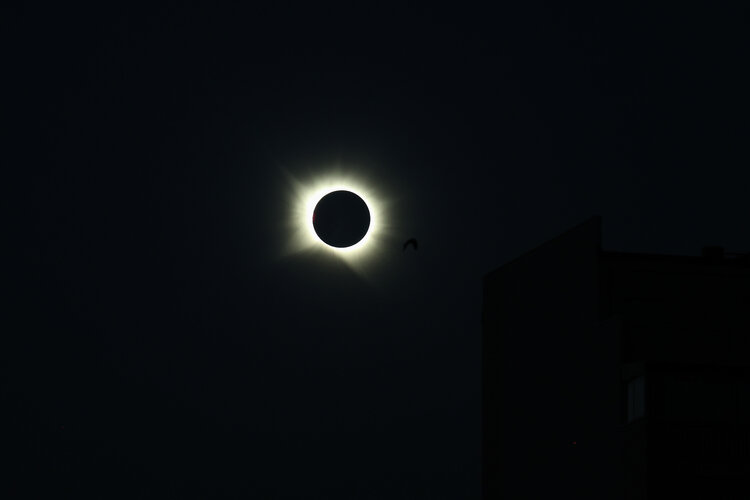
In a moment, darkness set in and the Sun’s outer atmosphere was revealed in all its glory. White streaks of light extended outwards in all directions, and bright red, glowing prominences clung close to the Sun’s surface.
“I think ‘boggles the mind’ sums it up,” says the European Space Agency's Director of Science Professor Carole Mundell, during ESA's live broadcast from the Observatorio Astrofísico de Javalambre, Spain. “The detail was incredible. This eerie, nighttime light is what it feels like, but it's not nighttime. Really very, very special.”
Below is a collection of images taking during the eclipse. Click the left and right arrows to move between them. ESA arranged for live telescope feeds from the Spanish sites of León, Palencia and Javalambre, and photographers across Europe shared their photos with us. Earth observation satellite MTG-I1 captured the Moon’s shadow moving across Earth, and ESA's artificial eclipse-maker Proba-3 captured a double eclipse from Earth orbit.
_Text continues after the images._
01. 1
02. 2
03. 3
04. 4
05. 5
06. 6
07. 7
08. 8
09. 9
10. 10
11. 11
12. 12
A live broadcast from the path of totality
Behind the scenes at ESA's solar eclipse broadcast – preparing for action
For those unable to travel to regions from where totality was visible, ESA's live broadcast allowed them to experience the eclipse together with scientists from ESA and the observatory.
Hosted by Dame Dr Maggie Aderin, the programme explored topics ranging from the mysteries of the Sun and its corona, to how one famous eclipse changed our understanding of gravity, and how ESA is now creating artificial solar eclipses in space.
Behind the scenes at ESA's solar eclipse broadcast – on set
The highlight was the coverage of 1 minute and 21 seconds of totality, as the Moon plunged Javalambre into complete darkness. As well as telescope images and drone shots of totality, we captured Maggie and Director of Science Carole's astonished responses to witnessing this extraordinary phenomenon.
You can rewatch the broadcast below.
Total solar eclipse 2026: Coming to Europe (Official ESA broadcast) - YouTube
Tap to unmute
Total solar eclipse 2026: Coming to Europe (Official ESA broadcast) European Space Agency, ESA
European Space Agency, ESA1.45M subscribers
Thousands of people gathered in León
Demonstrating how to turn light into sound
ESA, together with the City of León and the University of León, organised a free public event at the Palacio de Exposiciones y Congresos de León (Spain) on the day of the eclipse.
An estimated ten to twelve thousand people came for the pre-eclipse daytime programme, consisting of hands-on workshops, experiments and interactive activities designed for all ages. Click here for photos.
A highlight was the ‘an inclusive eclipse’ workshop, where members of ESA’s CESAR science education team demonstrated tools to experience an eclipse without using your eyes. From 3D printed tactile models of the Sun, Moon and Earth, to demonstrations using Micro:bit and LightSound sensors to turn changes in light experienced during an eclipse into changes in sound. Click here to listen to a more artistic sonification of the solar eclipse.
Presenting the 2026 European solar eclipse to a crowd in León
Another popular hands-on activity involved making your own pinhole camera. This is a method for safely viewing a (partial) eclipse by projecting the shape of the Sun inside a box.
A further 14 500 people attended the evening programme, which covered the eclipse itself. The programme included science talks and expert commentary to guide visitors through every stage of the eclipse, explaining what was happening in the sky and why this particular eclipse was so remarkable. Click here for photos.
When the eclipse began, everyone gathered in the viewing area. People used eclipse glasses or indirect methods such as a pinhole camera to safely observe the Sun. Many amateur astronomers and astrophotographers set up their own equipment at the site. A large screen showed ESA’s live telescope feed recorded at the site in León. Right after totality in León ended, visitors were shown the telescope feed of totality as seen from the ESA broadcast location near Teruel.
Trio of eclipses
Luckily, two more solar eclipses are heading to Europe. On 2 August 2027, the southern tip of Spain, North Africa and the Middle East will witness a super long totality during ‘the eclipse of the century’. And on 26 January 2028, Portugal and Spain will be treated to a ‘ring of fire’ annular solar eclipse.
Visit www.esa.int/solareclipse for all of ESA’s activities and resources related to this unique trio of eclipses.
An ESA team photo from León's eclipse event
Related Links
Story\\
\\

Focus on\\
\\

Focus on\\
\\
/images)
Focus on\\
\\

Focus on\\
\\

Focus on\\
\\

Focus on\\
\\
/images)
Story\\
\\

Story\\
\\

Story\\
\\
